
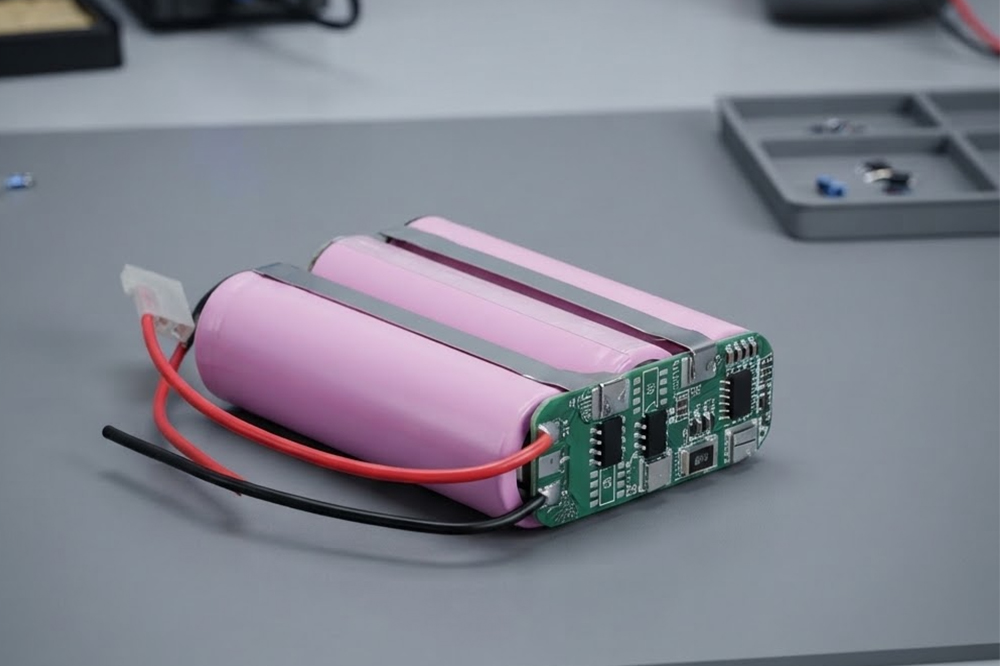
BMS is one of the key components in 18650 battery pack. The right BMS helps protect cells from overcharge, over-discharge, excessive current, and other operating problems. Choosing one should start with the battery configuration, voltage, current demand, and application rather than simply looking at the rated current.
Why Does 18650 Battery Pack Need a BMS?
An individual 18650 cell already has basic electrical characteristics, but a multi-cell battery pack introduces additional risks.
Series-connected cells must remain within an appropriate voltage range. During charging and discharging, small differences between cells can become larger. One cell may reach its upper voltage limit before the others, while another may become more deeply discharged.
That is where a battery management system becomes important.
A BMS monitors the battery pack and provides protection functions based on its design. Depending on the model, it may monitor cell voltage, pack current, temperature, and other operating conditions.
For a complete overview of battery pack construction, see our 18650 battery pack design guide before selecting the BMS.
1. Start With the Battery Configuration
The first number to check is the series configuration.
An 18650 pack might use:
- 1S2P
- 2S2P
- 3S2P
- 4S2P
- 5S2P
- 7S2P
- 10S2P
- 13S3P
- 15S4P
The “S” represents cells connected in series, while “P” represents cells connected in parallel.
A 4S battery pack, for example, uses four cell groups connected in series. If each cell has a nominal voltage of 3.7V, the pack has a nominal voltage of approximately 14.8V.
The BMS must match the number of series cells.
A 4S BMS should not be used for a 5S or 3S battery pack simply because the current rating looks suitable.
2. Check the BMS Voltage Rating
Voltage compatibility is essential.
Typical lithium-ion 18650 cells have a nominal voltage around 3.6V or 3.7V and a full-charge voltage of approximately 4.2V. Therefore, a 4S lithium-ion pack has a full-charge voltage of about 16.8V.

The same calculation can be applied to other configurations:
| Pack | Nominal Voltage | Full-Charge Voltage |
|---|---|---|
| 1S | 3.6–3.7V | 4.2V |
| 2S | 7.2–7.4V | 8.4V |
| 3S | 10.8–11.1V | 12.6V |
| 4S | 14.4–14.8V | 16.8V |
| 5S | 18–18.5V | 21V |
| 10S | 36–37V | 42V |
These values are useful when matching the BMS with the pack and charger.
For a deeper explanation, the article 18650 Battery Voltage Explained: 3.6V, 3.7V & 4.2V can help clarify the relationship between cell voltage and pack voltage.
3. Choose the Correct Discharge Current
Current is another major selection point.
Suppose an application requires 20A continuously. A BMS rated at 20A may appear to be the obvious choice. In practice, leaving some margin is usually more sensible.
The actual current requirement depends on the application, cell type, pack configuration, motor or electronic load, and peak power demand.
For example, a device may normally consume 10A but briefly require 25A during startup. The BMS needs to handle that operating condition without triggering unnecessary protection.
High-drain applications deserve particular attention. Our high-drain 18650 battery guide explains how discharge capability and cell selection affect pack performance.
4. Understand Continuous and Peak Current
BMS specifications sometimes list several current values.
You may see terms such as:
- Continuous discharge current
- Peak discharge current
- Charging current
- Over-current protection
- Short-circuit protection
These numbers should not be treated as interchangeable.
A BMS rated for 30A continuous current may have a different short-term peak capability. Likewise, the charging current can be lower than the discharge current.
When selecting a BMS for OEM battery packs, ask the supplier how the current rating was tested. The test conditions can make a significant difference.
5. Look at Cell Balancing
Cell balancing helps maintain a more consistent voltage level between series-connected cell groups.
Without balancing, differences between cells can gradually increase during repeated charge and discharge cycles.
Passive balancing is commonly used in many lithium-ion BMS designs. It removes a small amount of energy from cells with higher voltage so that the cell groups can move closer together.
More advanced battery systems may use active balancing, which transfers energy between cells rather than simply dissipating it.
For many standard 18650 battery packs, passive balancing can be sufficient. The appropriate solution depends on pack size, cell chemistry, application requirements, and cost.
6. Check the Protection Functions
A basic BMS may include several protection functions.
Common features include:
- Overcharge protection
- Over-discharge protection
- Over-current protection
- Short-circuit protection
- Over-temperature protection
- Charging temperature protection
- Cell balancing
Not every BMS provides the same combination.
Temperature monitoring is particularly useful for packs used under heavy loads. Heat can affect cell performance and accelerate degradation, so monitoring temperature adds another layer of protection.

7. Consider the BMS Temperature Sensor
Some BMS boards include an external temperature sensor.
The sensor can be positioned close to the cells or another area that needs monitoring. If the measured temperature exceeds the configured limit, the BMS can interrupt charging or discharging.
For compact battery packs, sensor placement matters.
A sensor attached to a cool area of the enclosure may not accurately represent the hottest part of the battery. During prototype development, checking actual pack temperature under load is therefore worthwhile.
8. BMS vs. Battery Charger
A common mistake is assuming that the BMS replaces the charger.
It does not.
The charger controls the charging process, while the BMS provides monitoring and protection. Both need to match the battery configuration.
For example, a 4S lithium-ion pack normally requires a charger designed for a 16.8V full-charge voltage.
Using the wrong charger can create serious problems even when the BMS itself is correctly selected.
9. BMS Selection for High-Drain 18650 Packs
High-drain battery packs require more than a high-current BMS.
The cells must also support the required discharge current.
Imagine a 2P configuration using cells rated for 10A continuous discharge. The theoretical cell-group capability may be around 20A, assuming appropriate operating conditions and cell matching.
A 40A BMS does not automatically turn this pack into a 40A battery.
The cells remain the limiting component.
Internal resistance also becomes increasingly important as current rises. Higher resistance can cause greater voltage drop and heat generation under load. For larger battery projects, review our guide to 18650 battery internal resistance before finalizing the design.
10. Match the BMS to the Battery Pack Layout
Physical design should not be ignored.
A BMS board needs enough space inside the enclosure. Its wiring must also reach the appropriate cell groups without creating unnecessary routing problems.
Consider:
- BMS board dimensions
- Wire length
- Connector type
- Cell arrangement
- Insulation
- Temperature sensor position
- Enclosure space
- Charging and discharge terminals
The electrical design and mechanical design should be developed together.
A BMS that works electrically may still be inconvenient if it cannot fit safely inside the final battery enclosure.
11. Common BMS Selection Mistakes
Several problems appear repeatedly during battery pack development.
Choosing only by current rating
A high-current BMS is not necessarily the right BMS. Series count, charging voltage, temperature protection, and communication requirements also matter.
Ignoring the cell discharge capability
The BMS cannot increase the current capability of the cells.
Using the wrong charger
The charger must match the battery chemistry and series configuration.
Mixing different cells
Cells with different capacities, ages, or internal resistance can create imbalance and inconsistent performance.
Leaving no thermal margin
A battery pack operating close to its maximum current continuously may generate substantial heat.
Installing the BMS without testing
A finished pack should be tested before it enters regular service or shipment.
12. Testing the BMS and Battery Pack
A practical test process can include:
- Check every cell group voltage.
- Verify the total pack voltage.
- Confirm the BMS series configuration.
- Test charging protection.
- Test discharge protection.
- Check over-current behavior.
- Check temperature monitoring.
- Confirm balancing behavior.
- Perform a controlled load test.
- Inspect wiring and insulation.
The exact test procedure should match the application and BMS specification.
Cell testing should also be part of the process. If you are working with used or reclaimed 18650 cells, our guide on how to test an 18650 battery provides a useful starting point.

A Simple 4S2P Example
Consider a battery pack built with eight 3000mAh 18650 cells in a 4S2P configuration.
The calculation is straightforward:
- Series count: 4S
- Parallel count: 2P
- Total cells: 8
- Nominal voltage: approximately 14.8V
- Capacity: approximately 6000mAh
- Full-charge voltage: 16.8V
This pack requires a 4S lithium-ion BMS.
The appropriate BMS current rating depends on the cells and application load. If the device requires a high discharge current, both the cell discharge rating and BMS current rating need to be checked together.
What Should You Ask a BMS Supplier?
Before ordering a BMS in bulk, provide the supplier with the actual battery requirements.
Useful information includes:
- Battery chemistry
- Series and parallel configuration
- Nominal voltage
- Maximum charging current
- Continuous discharge current
- Peak discharge current
- Operating temperature
- Cell type
- Required protection functions
- Communication requirements, if any
- Physical dimensions
Clear specifications reduce the chance of receiving a BMS that looks correct on paper but does not work well with the final battery pack.
BMS Selection for OEM and Wholesale Battery Packs
For a prototype, choosing a standard BMS may be enough.
Production projects can be different.
An OEM battery pack may require a customized protection board, different connectors, a specific board size, communication functions, or customized protection parameters.
That is why BMS selection should happen during the early battery design stage rather than after the pack has already been assembled.
For manufacturers and distributors sourcing cells in bulk, it is also useful to evaluate the cell supplier and BMS supplier together. Consistent cell specifications make pack assembly and quality control easier.
Apsenx provides 18650 lithium batteries for wholesale and OEM applications, including different capacity options for battery pack development.
Final Thoughts
The right BMS is closely connected to the entire battery design.
Series configuration determines the BMS voltage requirement. Cell capability affects the current requirement. Temperature, balancing, charger compatibility, and physical dimensions complete the picture.
For a reliable 18650 battery pack, do not select the BMS from one specification alone. Match the BMS to the cells, configuration, load, charger, and actual working environment.
FAQs
1. What BMS do I need for an 18650 battery pack?
The BMS should match the number of cells connected in series. A 4S pack requires a 4S BMS, while a 10S pack requires a 10S BMS.
2. Can I use a higher-current BMS?
Usually, a higher current rating is not a problem by itself, but the cells, wiring, connectors, and charger must also support the intended current. The BMS should be selected as part of the complete system.
3. Does every 18650 battery pack need a BMS?
For multi-cell lithium-ion packs, a properly designed BMS is strongly recommended for monitoring and protection. The exact design depends on the application and battery architecture.
4. Does BMS increase battery capacity?
No. Battery capacity mainly depends on the cell capacity and parallel configuration. A BMS manages and protects the battery; it does not increase its energy capacity.
5. Can I use 4S BMS on a 3S battery?
No. The BMS series configuration should match the battery pack. A mismatched BMS can cause incorrect voltage monitoring and charging behavior.
6. Does BMS replace a lithium-ion charger?
No. The charger supplies the appropriate charging voltage and current, while the BMS provides monitoring and protection.
7. Is a high-current BMS enough for a high-power battery pack?
No. The 18650 cells must also support the required discharge current. Cell capability, BMS rating, nickel strips, wiring, connectors, and thermal design all need to work together.
-

12V 4400 mah Lithium ion 3S2P 18650 Battery Pack
-

18650 2000mAh 3.7 volt Lithium-ion Battery
-

18650 20V 3.0Ah Cordless Drill battery
-

18650 22.2V 7.8Ah 2600Mah 6S3P Rechargeable Battery Pack
-

18650 2600mAh Rechargeable Lithium-Ion Battery 3.7V
-

18650 3.7V 10Ah Li-Ion Power Battery Pack
-

18650 3.7V 3300mah Rechargeable Lithium ion Battery
-

18650 7S7P 24V 14Ah Lithium ion Electric Scooter Battery Pack
-

18650 battery 3.7V 1500mAh Lithium-Ion Battery
-

18650 Battery 3500 mah Rechargeable Battery Cells
-

18650 Electric Scooter 48V 13000mAh Lithium Battery
-

2600mAh 3S1P 11.1V 18650 Battery Packs
-

3.7V Li ion Rechargeable 3000mah 18650 Battery Cell
-

36V 5200mAh 10S2P 18650 Battery Pack
-

48v 4400mah 13S2P 18650 Rechargeable Battery Pack
-

7S2P 24V 18650 Lithium Battery Pack
-

Electric Scooter 36V 4400mAH 10S2P 18650 Battery Pack
-

ICR 18650 Battery 2200mah 3.7V
Leave a Reply