
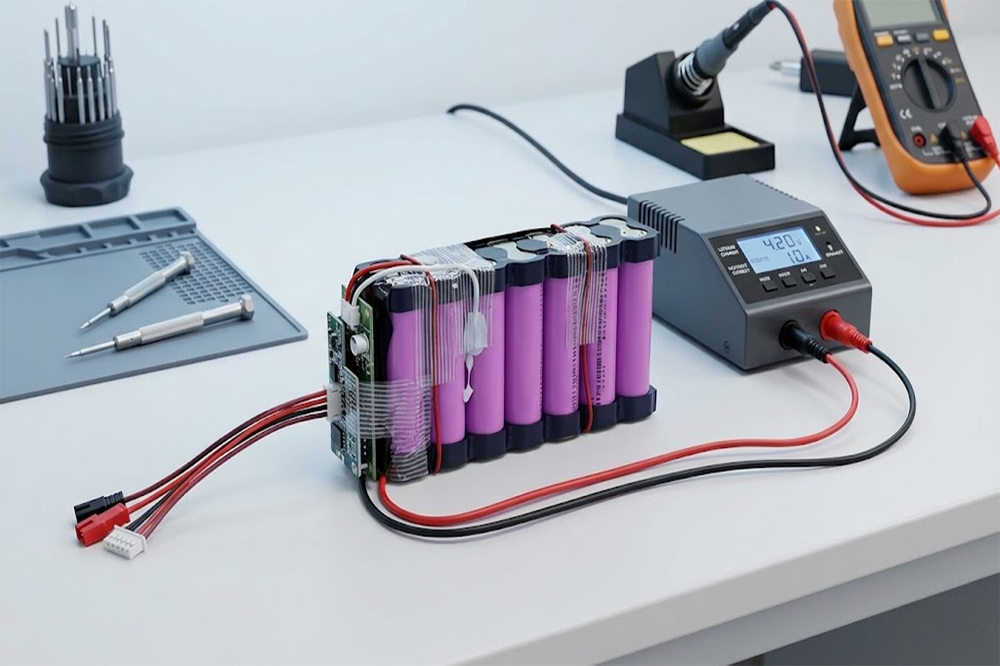
Choosing charger for 18650 battery pack is not simply a matter of finding one with the right plug. The charger voltage must match the battery configuration, while the charging current should fit the cells, BMS, and application. Connector type, charging method, protection features, and operating conditions also matter, especially when the battery pack is being produced in bulk.
Why Charger Selection Matters
An 18650 cell is only one part of a battery system.
Once several cells are connected in series and parallel, the charging requirements change. A 4S2P battery pack, for example, does not use the same charger as a single 18650 cell.
The charger needs to work with the complete battery architecture.
That means checking the cell chemistry, series count, full-charge voltage, recommended charging current, BMS, connector, and actual application before placing an order.
A charger that looks suitable from its output label may still be wrong for the battery pack.
1. Start With the Number of Cells in Series
The most important number is the series count.
For a typical lithium-ion 18650 cell with a nominal voltage of 3.6V or 3.7V and a full-charge voltage of 4.2V, the charger voltage can be calculated from the number of cells connected in series.
| Battery Configuration | Nominal Voltage | Full-Charge Voltage |
|---|---|---|
| 1S | 3.6–3.7V | 4.2V |
| 2S | 7.2–7.4V | 8.4V |
| 3S | 10.8–11.1V | 12.6V |
| 4S | 14.4–14.8V | 16.8V |
| 5S | 18–18.5V | 21V |
| 6S | 21.6–22.2V | 25.2V |
| 7S | 25.2–25.9V | 29.4V |
| 10S | 36–37V | 42V |
For example, a 4S 18650 battery pack normally needs a charger with a 16.8V output for a full charge.
The same principle applies to larger packs.
Before ordering a charger, confirm the actual cell chemistry and manufacturer’s specified charge voltage. Do not rely only on the nominal voltage printed on the battery.
For more detail on this topic, see our guide to 18650 Battery Voltage Explained: 3.6V, 3.7V & 4.2V.

2. Understand Nominal Voltage vs. Charging Voltage
This distinction causes many mistakes.
A lithium-ion 18650 cell may be described as a 3.7V cell. That does not mean you should charge it with a 3.7V charger.
The nominal voltage describes the approximate operating voltage of the cell. A standard lithium-ion cell normally reaches about 4.2V when fully charged.
Therefore:
3.7V ≠ charging voltage
For a 4S pack:
3.7V × 4 ≈ 14.8V nominal
But:
4.2V × 4 = 16.8V full charge
The charger must be designed around the full-charge voltage.
3. Choose the Correct Charging Current
Voltage gets most of the attention, but charging current matters just as much.
A battery pack may have a large capacity but still require a relatively modest charging current. The appropriate value depends on the cell specification, pack capacity, BMS, thermal design, and application.
Suppose a 4S2P pack uses eight 3000mAh cells.
The parallel configuration gives the pack approximately:
3000mAh × 2 = 6000mAh
The charging current should then be selected according to the cells’ recommended charging characteristics rather than simply choosing the largest available charger.
A faster charger is not automatically a better charger.
4. Consider C-Rate When Selecting Current
Charging current is often easier to understand through C-rate.
If a battery has a capacity of 6Ah:
- 0.5C = 3A
- 1C = 6A
- 2C = 12A
A 3A charging current corresponds to approximately 0.5C for 6Ah battery.
However, the calculation alone does not tell you what charging current is safe. The cell manufacturer should specify the recommended charging rate.
For an OEM battery project, the safest approach is to provide the cell model and battery configuration to the charger supplier and confirm the allowable charging current.
5. The BMS and Charger Need to Work Together
The charger and BMS perform different jobs.
The charger supplies controlled charging voltage and current. The BMS monitors the battery and protects it against conditions such as overcharge, over-discharge, over-current, and temperature problems.
Both components need to be compatible.
A properly selected charger should reach the required final voltage without forcing the BMS to operate outside its intended range.
Our previous article, 18650 Battery Pack BMS Guide, explains how series count, current rating, balancing, and protection functions affect BMS selection.
6. Does the BMS Control Charging?
It depends on the BMS design.
Many BMS boards provide charging protection, but that does not mean the charger can be ignored. The charger remains responsible for providing the appropriate charging profile.
Some battery systems use a dedicated charging control circuit or smart BMS with additional functionality.
For a simple battery pack, a conventional lithium-ion charger combined with an appropriate BMS may be sufficient.
More sophisticated products can require communication between the charger, BMS, and host system.
7. Choose the Correct Charger Type
Not every charger is designed for the same application.
Common charger categories include:
- Standard AC lithium battery chargers
- Desktop battery chargers
- Wall-plug chargers
- Industrial power supplies with charging control
- Multi-channel chargers
- Smart chargers
- Custom OEM chargers
A consumer device may need a compact wall charger.
An industrial battery pack could require a more robust charging solution with specific connectors, enclosure requirements, and charging parameters.
The physical environment often determines the best charger format.
8. Check the Connector
The output connector should match the battery pack.
Common options include barrel connectors, DC plugs, locking connectors, aviation-style connectors, and customized cable assemblies.
Connector polarity is equally important.
A charger with the correct voltage but incorrect polarity can damage equipment or create a safety hazard.
For production orders, confirm:
- Connector type
- Connector size
- Positive and negative polarity
- Cable length
- Wire gauge
- Connector locking mechanism
- Plug orientation
A small connector detail can become a surprisingly expensive problem when thousands of units are involved.
9. Check Charger Input Requirements
Output specifications are only part of the picture.
The charger also needs to work with the local electrical supply.
Depending on the target market, buyers may need different AC input plugs and electrical specifications.
For export projects, discuss:
- Input voltage
- Input frequency
- Plug type
- Cable requirements
- Charger enclosure
- Required regional compliance
These details should be confirmed before mass production rather than after the battery packs are completed.

10. Charging Time Depends on More Than Capacity
A common assumption is that a larger battery simply takes proportionally longer to charge.
Capacity is important, but charging time also depends on the charging current and the battery’s charging profile.
As a simplified example, a 6Ah battery charged at 3A might appear to need around two hours based on capacity alone.
Actual charging time can be longer because lithium-ion charging normally includes different charging stages. The current does not remain at the maximum level throughout the entire process.
Temperature and battery condition can also influence the result.
11. Do Not Choose Charger Only by Wattage
Some buyers compare chargers mainly by output power.
For example:
16.8V × 3A = 50.4W
That tells you the approximate maximum output power, but it does not prove that the charger is suitable for the battery.
A charger needs the correct output voltage and charging behavior first.
Power becomes useful when comparing suitable chargers. It should not be the first specification used to determine compatibility.
12. Charger Selection for High-Capacity 18650 Packs
Large 18650 battery packs can require higher charging current, but the cells and BMS must support it.
Imagine a 10S4P pack using 3000mAh cells.
The approximate capacity is:
3Ah × 4 = 12Ah
The nominal voltage is approximately:
3.7V × 10 = 37V
A typical full-charge voltage for a standard 10S lithium-ion pack is:
4.2V × 10 = 42V
The charger therefore needs to be designed around the 42V charging voltage.
Current selection comes next.
If the battery manufacturer recommends a particular charging rate, the charger should stay within that specification.
13. Charging Current and Battery Temperature
Higher charging current generally means more heat generation.
Heat can come from the cells, BMS, connectors, wires, and charging circuitry.
A compact battery enclosure may have limited ability to remove this heat.
For this reason, charging performance should be tested under realistic conditions rather than only checking the charger output on a workbench.
Temperature testing becomes especially important when:
- The battery is enclosed tightly.
- The charging current is relatively high.
- The battery is used in a warm environment.
- The pack contains many cells.
- The product has limited ventilation.
14. Avoid Using Unregulated Power Supply
A basic DC power supply is not automatically a lithium-ion battery charger.
Lithium-ion batteries require controlled charging.
A suitable charger normally follows an appropriate charging method and terminates or changes its behavior when the battery reaches the specified voltage.
Simply applying a fixed voltage source to a lithium-ion pack without proper charging control can create unsafe conditions.
This is particularly important for multi-cell packs.

15. Charger Selection for OEM Battery Packs
OEM projects often need more than a standard charger from a catalog.
The customer may need a customized connector, cable length, charging current, enclosure, branding, or electrical configuration.
Battery and charger development should ideally happen together.
For example, an OEM customer developing a 5S 18650 battery pack can first confirm:
- Cell model
- 5S configuration
- Battery capacity
- Maximum charging current
- BMS specifications
- Required full-charge voltage
- Charger connector
- Target market
Once these details are fixed, the charger specification becomes much clearer.
16. Common Charger Selection Mistakes
Using the nominal voltage as the charger voltage
A 3.7V cell does not use a 3.7V charger for normal full charging.
Ignoring the series count
The charger voltage must match the complete series configuration.
Choosing the highest current available
More current is not always better. The cell and BMS specifications set practical limits.
Using the wrong connector
Voltage compatibility does not guarantee mechanical or electrical compatibility.
Treating a power supply as a charger
A power supply and a dedicated lithium-ion charger are not necessarily the same thing.
Forgetting temperature testing
Charging a battery inside its final enclosure can produce different thermal results from charging an open prototype.
17. A Practical Charger Selection Checklist
Before purchasing a charger for an 18650 battery pack, confirm the following:
- Battery chemistry
- Number of cells in series
- Number of cells in parallel
- Nominal battery voltage
- Full-charge voltage
- Battery capacity
- Recommended charging current
- BMS specifications
- Connector type
- Connector polarity
- Cable length
- Input voltage
- Plug type
- Operating temperature
- Charger dimensions
- Required certifications or market-specific requirements
A simple checklist can prevent most basic compatibility problems.
Example: Selecting Charger for 4S2P Pack
Consider 18650 battery pack using eight 3000mAh cells in a 4S2P configuration.
The pack specification is approximately:
- Configuration: 4S2P
- Cells: 8
- Nominal voltage: 14.8V
- Full-charge voltage: 16.8V
- Capacity: 6Ah
A suitable charger would therefore be designed for a 16.8V lithium-ion battery pack.
The charging current still needs to be selected according to the cell manufacturer’s charging specification and the BMS design.
If the application has strict charging-time requirements, the pack designer can then evaluate whether a higher charging current is appropriate.
Working With Battery Manufacturer
For wholesale and OEM projects, charger selection is easier when the battery specification is already clear.
A battery manufacturer can help confirm the relationship between the cells, pack configuration, BMS, and charging requirements.
This is especially useful when the final product requires a customized battery pack rather than standard loose cells.
Apsenx supplies 18650 lithium-ion cells for OEM and wholesale battery applications, making cell selection an important first step before developing the complete charging system.
Final Thoughts
The right charger starts with the battery, not the other way around.
Check the series configuration first. Calculate the full-charge voltage next. Then consider charging current, BMS compatibility, connector design, temperature, and the actual operating environment.
For a production battery pack, these details should be confirmed before mass ordering.
A charger that fits the battery electrically, mechanically, and thermally will make the final system much easier to manage.
FAQs
1. What charger do I need for 4S 18650 battery pack?
A typical 4S lithium-ion 18650 pack reaches 16.8V when fully charged, so a compatible charger should be designed for a 16.8V lithium-ion battery pack.
2. Can I charge 18650 battery with phone charger?
Not directly. A typical phone charger is not designed to provide the correct charging profile for an 18650 lithium-ion cell or multi-cell battery pack.
3. What voltage should I use to charge 3.7V 18650 battery?
For a standard lithium-ion 18650 cell with a 4.2V full-charge specification, the charging voltage is typically 4.2V. Always follow the cell manufacturer’s specification.
4. How do I choose the charging current?
Start with the cell manufacturer’s recommended charging current. Then check the battery capacity, BMS rating, thermal design, and required charging time.
5. Can I use higher-current charger?
Only when the battery cells, BMS, wiring, connectors, and charging design all support the higher current. A higher-rated charger should not automatically be assumed to be safer or faster.
6. Does 4S2P battery need 4S charger?
Yes. The charger must match the battery’s series configuration and full-charge voltage. A typical 4S lithium-ion pack requires a 16.8V charging voltage.
7. Can BMS replace the charger?
No. A BMS provides battery monitoring and protection, while the charger supplies controlled charging power.
8. How long does it take to charge 18650 battery pack?
Charging time depends on battery capacity, charging current, cell specifications, and the charging profile. A simple capacity/current calculation provides only an estimate.
-

12V 4400 mah Lithium ion 3S2P 18650 Battery Pack
-

18650 2000mAh 3.7 volt Lithium-ion Battery
-

18650 20V 3.0Ah Cordless Drill battery
-

18650 22.2V 7.8Ah 2600Mah 6S3P Rechargeable Battery Pack
-

18650 2600mAh Rechargeable Lithium-Ion Battery 3.7V
-

18650 3.7V 10Ah Li-Ion Power Battery Pack
-

18650 3.7V 3300mah Rechargeable Lithium ion Battery
-

18650 7S7P 24V 14Ah Lithium ion Electric Scooter Battery Pack
-

18650 battery 3.7V 1500mAh Lithium-Ion Battery
-

18650 Battery 3500 mah Rechargeable Battery Cells
-

18650 Electric Scooter 48V 13000mAh Lithium Battery
-

2600mAh 3S1P 11.1V 18650 Battery Packs
-

3.7V Li ion Rechargeable 3000mah 18650 Battery Cell
-

36V 5200mAh 10S2P 18650 Battery Pack
-

48v 4400mah 13S2P 18650 Rechargeable Battery Pack
-

7S2P 24V 18650 Lithium Battery Pack
-

Electric Scooter 36V 4400mAH 10S2P 18650 Battery Pack
-

ICR 18650 Battery 2200mah 3.7V
Leave a Reply