
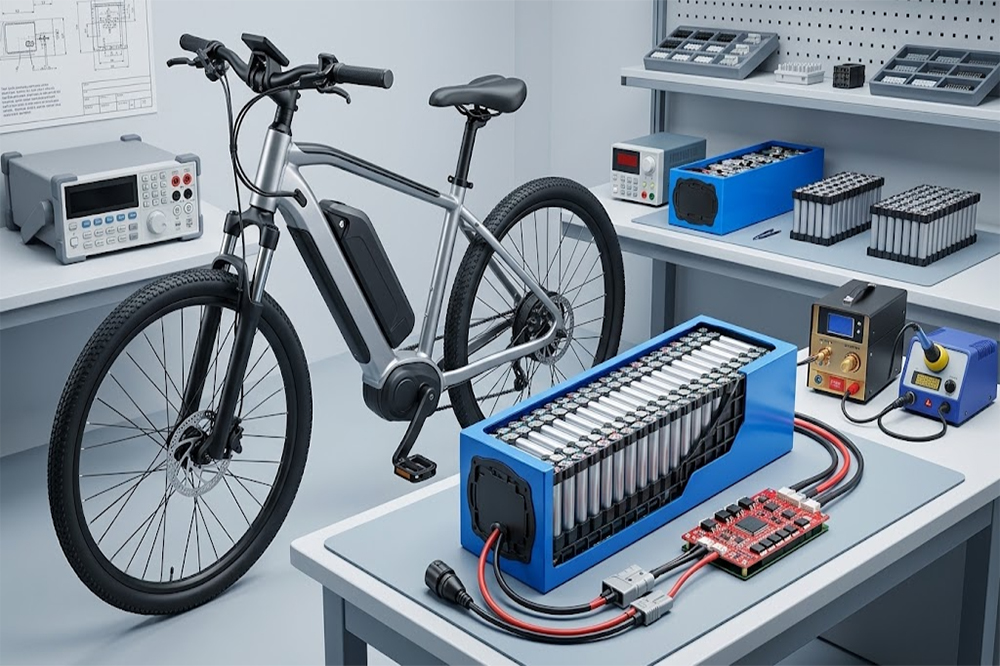
18650 lithium-ion cells are widely used in compact battery packs because they offer a useful balance between energy density, size, weight, and cost. For e-bike applications, cell selection should consider more than capacity. Discharge current, pack configuration, BMS, charging requirements, thermal management, and physical dimensions all affect the final battery’s performance.
Why Are 18650 Batteries Used in E-Bikes?
An e-bike battery needs to deliver enough energy while remaining reasonably compact and lightweight.
That makes cylindrical lithium-ion cells attractive for battery pack manufacturers. The 18650 format has a relatively small cylindrical design, allowing multiple cells to be arranged into different series and parallel configurations.
Pack designers can adjust voltage by changing the number of cells in series. Capacity and current capability can then be increased by adding cells in parallel.
This flexibility makes 18650 cells suitable for different e-bike battery architectures.
The cell itself, however, is only one part of the system. A reliable e-bike battery also needs appropriate cell matching, a BMS, charger, mechanical protection, insulation, and thermal design.
1. Choose the Right 18650 Cell Capacity
Capacity is usually expressed in mAh or Ah.
Common 18650 capacities include:
- 2000mAh
- 2600mAh
- 3000mAh
- 3300mAh
- 3500mAh
Higher capacity can increase the energy available from the battery pack.
For example, if a pack uses two 3000mAh cells in parallel:
3000mAh × 2 = 6000mAh
Adding more cells in parallel increases capacity further.
That does not mean the highest-capacity cell is always the best option. An e-bike may have a relatively high power demand, so discharge capability needs to be considered alongside capacity.
For a broader explanation of mAh, Ah, and Wh, see our 18650 Battery Capacity Guide.
2. Check the Motor Power
Motor power has a direct influence on battery requirements.
A low-power commuter e-bike may have a very different battery requirement from a high-power electric bicycle designed for steep terrain.
For example, a system using a 250W motor does not necessarily need the same battery configuration as a 750W system.
The actual electrical demand can also change with:
- Rider weight
- Hills
- Acceleration
- Wind
- Tire pressure
- Riding speed
- Temperature
- Controller settings
Real-world riding conditions can therefore create short periods of much higher current demand than the nominal motor rating suggests.
3. Understand Voltage and Series Configuration
E-bike batteries commonly use multiple lithium-ion cells connected in series.
The series count determines the nominal voltage.
For standard 3.6V–3.7V lithium-ion cells:
| Configuration | Approx. Nominal Voltage | Approx. Full-Charge Voltage |
|---|---|---|
| 10S | 36–37V | 42V |
| 13S | 46.8–48.1V | 54.6V |
| 14S | 50.4–51.8V | 58.8V |
A typical 36V-class battery may use a 10S configuration.
A 48V-class battery commonly uses 13 cells in series.
The exact configuration should always match the motor controller, BMS, charger, and system specification.
Our 18650 Battery Voltage Explained article provides more detail on nominal and full-charge voltage.
4. Parallel Configuration Determines Capacity
Series cells increase voltage.
Parallel cells increase capacity and can also increase available current.
Consider a 13S3P battery using 3000mAh cells.
The capacity is approximately:
3Ah × 3 = 9Ah
The total number of cells is:
13 × 3 = 39 cells
Nominal energy can be estimated as:
48.1V × 9Ah ≈ 433Wh
The actual usable energy depends on operating conditions, battery management, discharge limits, and other system factors.
This is why e-bike battery specifications should be evaluated using the complete pack rather than the capacity of one cell.

5. Capacity Is Not the Same as Power
A common misunderstanding is that a higher mAh rating automatically means a more powerful battery.
It does not.
Capacity tells you approximately how much charge the battery can store. Discharge capability tells you how much current the cells can provide under specified conditions.
An e-bike that requires strong acceleration may need cells with good high-current performance even if a lower-capacity cell would provide enough energy.
For demanding applications, review our High-Drain 18650 Battery Guide before selecting the cells.
6. Check the Cell Discharge Current
Suppose each 18650 cell is rated for 10A continuous discharge.
A 3P configuration may theoretically provide a higher current capability than a single cell because the current is distributed among the parallel cells.
However, real battery design should not simply multiply the printed current rating.
Temperature, cell age, internal resistance, wiring, nickel strips, BMS limits, and manufacturer test conditions all matter.
The safest approach is to design with an appropriate operating margin rather than continuously pushing cells to their maximum rating.
7. Why Internal Resistance Matters
Internal resistance affects voltage drop and heat generation.
When an e-bike accelerates, current can rise quickly. Cells with higher internal resistance may experience greater voltage drop under load.
That can result in:
- Lower pack voltage under acceleration
- More heat
- Reduced efficiency
- Greater stress on the cells
- Less consistent performance
Cell matching becomes especially important when building a larger e-bike battery.
Our 18650 Battery Internal Resistance Guide explains how resistance can be measured and evaluated.
8. Use a Suitable BMS
The BMS is an important part of an e-bike battery pack.
A suitable BMS may provide protection against:
- Overcharge
- Over-discharge
- Over-current
- Short circuit
- Excessive temperature
- Cell imbalance
The BMS must also match the battery’s series configuration.
For example, a 13S battery needs a BMS designed for a 13S lithium-ion pack.
Current capability matters as well. A BMS with a current rating below the application’s actual requirements can cause unwanted protection events during acceleration or heavy loads.
Our previous 18650 Battery Pack BMS Guide covers this selection process in more detail.

9. Choose the Right Charger
The charger must match the battery pack’s full-charge voltage.
For a typical 13S lithium-ion battery:
4.2V × 13 = 54.6V
Therefore, the charging system needs to be designed around the 54.6V full-charge voltage.
A 10S pack has a typical full-charge voltage of:
4.2V × 10 = 42V
Using the wrong charger can cause charging problems even when the battery cells themselves are suitable.
The charger should also be compatible with the battery’s charging current and BMS design.
For more information, see our How to Choose a Charger for an 18650 Battery Pack guide.
10. Cell Matching Is Important
An e-bike battery may contain dozens of 18650 cells.
Using cells with different capacities, internal resistance, ages, or performance characteristics can create imbalance between parallel and series groups.
For production battery packs, manufacturers normally establish cell selection and matching procedures before assembly.
Important parameters can include:
- Capacity
- Internal resistance
- Voltage
- Cell model
- Production batch
- Physical condition
Good matching helps create a more consistent battery pack.
11. Physical Design Matters
The battery has to fit somewhere on the e-bike.
Common battery locations include:
- Down tube
- Rear rack
- Seat tube
- Frame-integrated enclosure
- External battery case
The available space affects the cell arrangement.
A pack with the required electrical specifications may still be unsuitable if the dimensions do not fit the enclosure.
Designers should consider:
- Battery length
- Width
- Height
- Cell orientation
- BMS location
- Wiring
- Connector position
- Mounting system
- Waterproofing
- Shock protection
Mechanical design should begin alongside electrical design.
12. Thermal Management for E-Bike Batteries
An e-bike battery can experience heat during both riding and charging.
Heavy acceleration, long climbs, high ambient temperature, and high charging current can increase thermal stress.
The enclosure therefore needs to protect the cells while allowing the battery system to manage heat appropriately.
A compact enclosure can create an additional challenge. There may be very little free space around the cells and BMS.
Temperature testing under realistic riding and charging conditions can reveal problems that are difficult to see during a basic electrical test.
13. Spot Welding and Pack Construction
Most cylindrical 18650 battery packs use welded connections rather than directly soldering wires to the cell terminals.
Nickel strips are commonly used to connect cells.
The welding process needs to provide a reliable electrical connection without exposing the cells to unnecessary heat.
Cell holders, insulation rings, fish paper, heat-shrink material, and other protective components can also be used during assembly.
Our 18650 Battery Spot Welding Guide explains the basic welding process and common quality problems.

14. How Many 18650 Cells Does an E-Bike Battery Need?
There is no single answer.
The number depends on:
- Battery voltage
- Capacity
- Cell capacity
- Required current
- Available space
- Target range
- Motor and controller
- Battery enclosure
For example, a 13S3P pack uses:
13 × 3 = 39 cells
If 3000mAh cells are used, the pack capacity is approximately:
3Ah × 3 = 9Ah
That gives a nominal energy of approximately:
48.1V × 9Ah ≈ 433Wh
A 13S4P configuration would use 52 cells and provide greater capacity if the same 3000mAh cells were selected.
15. Range Depends on More Than Battery Capacity
Battery capacity is important, but it does not directly guarantee a specific riding distance.
Energy consumption changes with riding conditions.
A rider traveling on flat roads at moderate speed may consume much less energy than someone frequently climbing steep hills.
Other factors include:
- Rider and cargo weight
- Speed
- Terrain
- Wind
- Tire pressure
- Pedal assistance level
- Motor efficiency
- Temperature
For this reason, manufacturers should be careful when making range claims.
Battery energy in Wh provides a more useful starting point than simply quoting Ah.
16. Common Mistakes When Choosing 18650 Cells for E-Bikes
Choosing capacity without checking current
A high-capacity cell may not provide the required discharge performance.
Selecting a BMS by voltage only
Current capability and protection functions matter too.
Mixing different cell types
Different cells can behave differently under load and during charging.
Ignoring internal resistance
Resistance affects voltage drop and heat.
Designing the battery before checking the enclosure
A battery that works electrically may not fit physically.
Using an unsuitable charger
The charger must match the battery’s full-charge voltage.
Ignoring thermal conditions
Heavy loads and hot environments can increase battery temperature.
17. Custom 18650 E-Bike Battery Packs
Standard battery packs work well for many applications.
OEM projects often need something different.
An e-bike manufacturer may require a specific voltage, capacity, enclosure size, connector, mounting system, BMS configuration, or cable length.
Custom battery development normally starts with the application requirements.
A manufacturer can then select the appropriate 18650 cells, determine the series and parallel configuration, design the BMS system, and develop the physical pack around the available installation space.
For wholesale buyers, specifying the complete battery requirement is usually more effective than simply asking for “18650 batteries for e-bikes.”
18. What Should E-Bike Battery Buyers Ask a Supplier?
Before ordering cells or complete battery packs, provide clear information about the application.
Useful specifications include:
- Target battery voltage
- Capacity requirement
- Motor power
- Controller current
- Desired riding range
- Maximum discharge current
- Charging current
- Battery dimensions
- Connector type
- Installation position
- Operating temperature
- Quantity
- OEM requirements
This information allows the supplier to recommend a more appropriate cell and pack configuration.
Final Thoughts
18650 cells can be a practical choice for e-bike battery packs, but selecting the cell by mAh alone is not enough.
Voltage, capacity, discharge current, internal resistance, BMS, charger, thermal performance, and physical dimensions all work together.
A well-designed e-bike battery starts with the application. Once the power demand and available space are understood, the cell configuration becomes much easier to determine.
For OEM and wholesale projects, working with a battery manufacturer early in the design process can also simplify cell selection, pack development, and production planning.
FAQs
1. Are 18650 batteries good for e-bikes?
Yes. 18650 lithium-ion cells can be used to build compact battery packs with different voltage, capacity, and current configurations. The appropriate cell depends on the e-bike’s electrical requirements.
2. How many 18650 cells are needed for an e-bike?
It depends on the battery voltage and capacity. A 13S3P configuration, for example, requires 39 cells.
3. How many 18650 cells are needed for a 48V e-bike battery?
A typical 48V-class lithium-ion battery uses a 13S configuration. The number of parallel cells determines the capacity and total number of cells. A 13S3P pack uses 39 cells, while a 13S4P pack uses 52 cells.
4. What 18650 capacity is best for an e-bike?
There is no universal best capacity. Higher-capacity cells can increase energy per cell, while high-drain cells may be more suitable for applications with higher current demand.
5. Does an e-bike battery need a BMS?
A properly designed multi-cell lithium-ion battery pack should include suitable monitoring and protection. The BMS should match the pack configuration and application requirements.
6. What charger does a 48V 18650 battery need?
A typical 13S lithium-ion battery has a full-charge voltage of 54.6V, so its charger should be designed for the appropriate 54.6V charging specification.
7. Can I use any 18650 battery in an e-bike?
No. Cells differ in capacity, discharge capability, internal resistance, chemistry, and quality. The cell needs to match the battery’s electrical and mechanical requirements.
8. Is a higher mAh 18650 always better?
No. Capacity is only one specification. For high-power e-bike applications, discharge capability, internal resistance, thermal performance, and cell quality are also important.
-

12V 4400 mah Lithium ion 3S2P 18650 Battery Pack
-

18650 2000mAh 3.7 volt Lithium-ion Battery
-

18650 20V 3.0Ah Cordless Drill battery
-

18650 22.2V 7.8Ah 2600Mah 6S3P Rechargeable Battery Pack
-

18650 2600mAh Rechargeable Lithium-Ion Battery 3.7V
-

18650 3.7V 10Ah Li-Ion Power Battery Pack
-

18650 3.7V 3300mah Rechargeable Lithium ion Battery
-

18650 7S7P 24V 14Ah Lithium ion Electric Scooter Battery Pack
-

18650 battery 3.7V 1500mAh Lithium-Ion Battery
-

18650 Battery 3500 mah Rechargeable Battery Cells
-

18650 Electric Scooter 48V 13000mAh Lithium Battery
-

2600mAh 3S1P 11.1V 18650 Battery Packs
-

3.7V Li ion Rechargeable 3000mah 18650 Battery Cell
-

36V 5200mAh 10S2P 18650 Battery Pack
-

48v 4400mah 13S2P 18650 Rechargeable Battery Pack
-

7S2P 24V 18650 Lithium Battery Pack
-

Electric Scooter 36V 4400mAH 10S2P 18650 Battery Pack
-

ICR 18650 Battery 2200mah 3.7V
Leave a Reply