
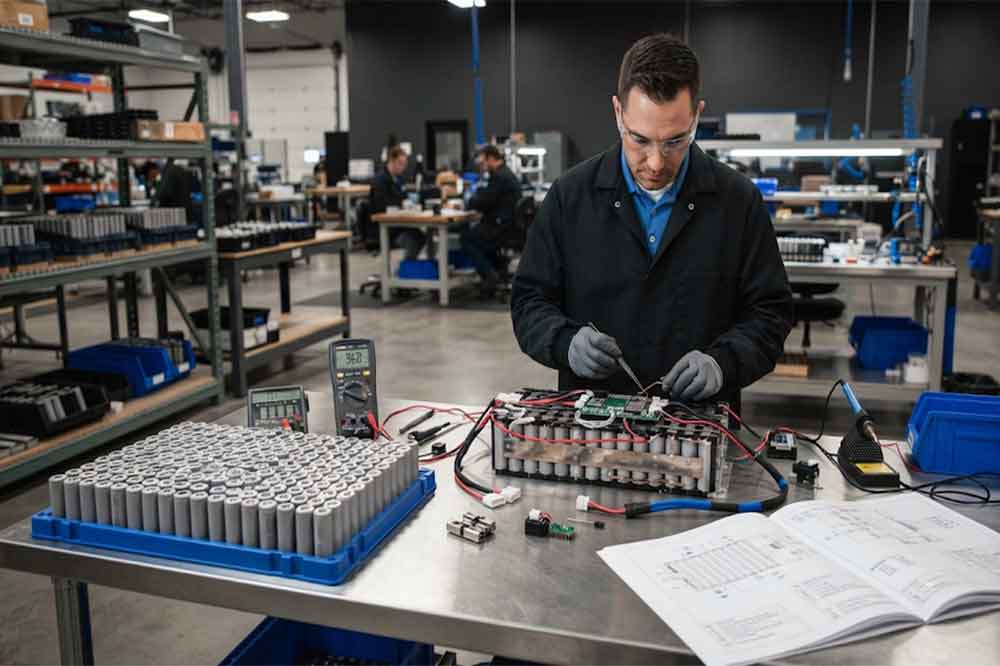
Standard 18650 battery cells are widely used in custom lithium-ion battery packs.
Their compact size makes them suitable for many OEM designs. They can also be arranged in different series and parallel configurations to meet voltage and capacity requirements.
However, choosing a standard 18650 cell for an OEM battery pack is not as simple as selecting a 3000mAh or 3500mAh cell.
The cell must match the complete pack design.
Voltage, capacity, discharge current, internal resistance, dimensions, BMS, temperature, cell matching, and long-term supply all matter.
This guide explains what OEM buyers should check before selecting standard 18650 cells for custom battery packs.
What Is a Standard 18650 Battery Cell?
An 18650 cell is a cylindrical lithium-ion cell with an approximate diameter of 18mm and length of 65mm.
The actual dimensions can vary slightly by model.
The 18650 format is popular because it offers a useful balance between energy density, size, availability, and pack design flexibility.
Different 18650 cells can have very different specifications.
For example, common capacity ranges include:
- 2000mAh
- 2200mAh
- 2500mAh
- 2600mAh
- 2800mAh
- 3000mAh
- 3200mAh
- 3500mAh
Not every capacity is available in every cell model.
More importantly, capacity alone does not define the cell.
Two 3000mAh 18650 cells may have different discharge ratings, internal resistance, cycle performance, and operating temperatures.
For OEM projects, the exact cell model matters.
Why Use Standard 18650 Cells for OEM Battery Packs?
Standard cells can simplify battery pack development.
The cell format is already established. Engineers can therefore design the pack around a known cylindrical cell size.
Standard 18650 cells also support different pack configurations.
For example:
10S4P
means 10 cells or parallel groups in series, with four cells in parallel in each group.
The total cell count is:
10 × 4 = 40 cells
Using 3000mAh cells, the approximate pack capacity is:
4 × 3.0Ah = 12Ah
The nominal voltage is approximately:
10 × 3.6V = 36V
This flexibility makes 18650 cells useful for many custom battery designs.
Standard 18650 Cell Specifications OEM Buyers Should Check
Before requesting a quotation, define the cell requirements clearly.

A basic specification should include:
| Specification | What to Check |
|---|---|
| Cell format | 18650 |
| Chemistry | Lithium-ion chemistry |
| Nominal voltage | Usually around 3.6V–3.7V |
| Capacity | Rated mAh |
| Continuous current | Application requirement |
| Peak current | Startup or short-duration load |
| Internal resistance | Cell performance and consistency |
| Dimensions | Diameter and length |
| Weight | Pack weight calculation |
| Operating temperature | Application environment |
| Terminal type | Flat top or button top |
| Cycle requirements | Expected service life |
| Datasheet | Manufacturer specification |
The exact values should come from the selected cell model.
Do not use a general 18650 specification as the final production specification.
18650 Capacity: 2000mAh to 3500mAh
Capacity is one of the first specifications buyers compare.
A 2000mAh cell provides about 2.0Ah.
A 3000mAh cell provides about 3.0Ah.
A 3500mAh cell provides about 3.5Ah.
At a nominal voltage of 3.6V, the approximate energy per cell is:
| Cell Capacity | Approx. Energy |
|---|---|
| 2000mAh | 7.2Wh |
| 2600mAh | 9.36Wh |
| 3000mAh | 10.8Wh |
| 3500mAh | 12.6Wh |
Higher capacity can reduce the number of parallel cells needed.
However, the highest mAh rating is not automatically the best choice.
The cell must also meet the required current and thermal conditions.
For a detailed comparison, see [2000mAh vs 2600mAh vs 3000mAh vs 3500mAh 18650 Battery].
High Capacity vs High Discharge 18650 Cells
OEM battery packs often face a trade-off between energy and power.
A high-capacity cell can provide more energy per cell.
A high-discharge cell may provide stronger current performance.
These characteristics are not always found in the same cell.
For example, a power tool may need high current for motor startup.
A portable electronic device may place more emphasis on runtime.
Therefore, the cell selection should start with the application load.
Check:
- Continuous current
- Peak current
- Runtime
- Pack capacity
- Temperature
- Available space
- Expected cycle life
For more detail, see [High Capacity vs High Discharge 18650 Batteries].
How Series and Parallel Configuration Affect the Pack
The cell itself does not determine the final battery voltage.
The pack configuration does.
In a basic design:
Series connection increases voltage.
Parallel connection increases capacity and current capability.
For example:
10S2P
- 20 cells
- About 36V nominal
- Capacity = cell capacity × 2
10S4P
- 40 cells
- About 36V nominal
- Capacity = cell capacity × 4
13S4P
- 52 cells
- About 46.8V nominal
- Capacity = cell capacity × 4
The actual voltage depends on the selected cell’s nominal and maximum voltage.
The BMS must also match the series configuration.
For more details, see [18650 Battery Series and Parallel: Understanding S and P Configurations].
Example: Designing 36V 12Ah OEM Battery Pack
Suppose an OEM project needs approximately:
36V nominal
12Ah capacity
10A continuous current
A 10S configuration is commonly used for a 36V-class pack.
Now consider 3000mAh cells.
The required parallel capacity is:
12Ah ÷ 3Ah = 4P
Therefore:
10S4P
The total cell count is:
10 × 4 = 40 cells
The approximate nominal energy is:
36V × 12Ah = 432Wh
This is only a starting point.
The selected cell must still meet the 10A pack current requirement.
The BMS, wiring, nickel or busbar design, enclosure, charger, and thermal conditions must also be checked.
Physical Dimensions Matter
The 18650 format is standardized in name.
It does not mean every cell has exactly the same physical dimensions.
Some cells can be slightly longer because of construction details, protection components, or terminal design.
This can affect the battery enclosure.
Before mass production, confirm:
- Cell diameter
- Cell length
- Terminal height
- Terminal type
- Cell weight
- Insulation thickness
- Holder dimensions
A few millimeters can matter when the pack has a tight enclosure.
This is especially important for custom battery packs with molded housings.
Flat Top vs Button Top
Terminal design is another detail OEM buyers should confirm.
A flat-top 18650 cell has a relatively flat positive terminal.
A button-top cell has a raised positive terminal.
The difference can affect the mechanical design and connection method.
For welded battery packs, the cell terminal and connection method should be confirmed before production.
Do not assume that all 18650 cells use the same terminal structure.
Internal Resistance and Cell Quality
Internal resistance affects battery behavior under load.
A simplified relationship is:
Voltage Drop ≈ Current × Internal Resistance
Higher resistance can result in greater voltage drop at the same current.
It can also increase heat generation.
For OEM packs, resistance consistency matters as well.
A pack contains multiple cells.
Large differences between cells can affect group consistency.
Therefore, the buyer should ask how the supplier tests and sorts cells before pack assembly.
For more information, see [18650 Battery Cell Matching: Why Capacity and Resistance Matter].
Cell Matching for Custom Battery Packs
Cell matching is an important part of OEM battery manufacturing.
Cells from the same model are not necessarily identical.

There can be differences in:
- Capacity
- Internal resistance
- Open-circuit voltage
- Self-discharge
- Production batch
- Aging condition
A typical matching process may include:
- Visual inspection
- Voltage measurement
- Internal resistance testing
- Capacity testing
- Sorting
- Grouping
- Pack assembly
- Final pack testing
The exact matching tolerance should be defined according to the cell model and application.
There is no single universal tolerance for every 18650 battery pack.
BMS Selection Must Match the Cell Configuration
The BMS is not an optional detail.
It must match the battery pack design.
For example, a 10S battery pack requires a BMS designed for a 10-series configuration.
The BMS selection should also consider:
- Charge voltage
- Discharge current
- Peak current
- Overcharge protection
- Over-discharge protection
- Overcurrent protection
- Short-circuit protection
- Temperature monitoring
- Cell balancing
The BMS cannot compensate for poor cell selection.
A good BMS works together with properly selected and matched cells.
Charger Compatibility
The charger must match the battery pack voltage and chemistry.
For example, a typical 10S lithium-ion pack has a maximum charge voltage around:
10 × 4.2V = 42V
The nominal voltage is around 36V.
Therefore, the charger specification must match the completed pack.
This is an important point during OEM development.
Do not select the charger only from the nominal battery voltage.
The maximum charging voltage must also be considered.
Temperature and Operating Environment
Battery performance changes with temperature.
A battery used indoors has different requirements from one used outdoors in hot or cold conditions.
OEM buyers should define the expected operating environment.
Consider:
- Charging temperature
- Discharging temperature
- Storage temperature
- Continuous load
- Peak load
- Ventilation
- Enclosure heat dissipation
Thermal design becomes more important as pack current increases.
A compact enclosure can also make heat management more difficult.
Therefore, the battery pack should be tested under realistic operating conditions.
Standard Cells Still Need Application Testing
A datasheet provides important information.
It does not replace testing.
Before mass production, OEM buyers should evaluate samples.
A practical sample test can include:
Capacity Test
Measure actual capacity under the agreed test conditions.
Discharge Test
Check voltage behavior at the expected operating current.
Resistance Test
Compare cell resistance and consistency.
Temperature Test
Monitor cell and pack temperature during charge and discharge.
Cycle Test
Evaluate capacity retention under the expected operating conditions.
Pack Test
Test the complete battery pack rather than only individual cells.
The final test plan should reflect the actual application.
Why the Same 18650 Cell Can Perform Differently in Different Packs
Battery pack performance does not depend only on the cell.
The complete design also includes:
- Series count
- Parallel count
- BMS
- Connection resistance
- Wiring
- Busbars or nickel strips
- Enclosure
- Cooling
- Charger
- Load profile
For example, the same 3000mAh cell can be used in different 10S configurations.
A 10S2P pack and a 10S6P pack use the same cell type.
However, their capacity and current-sharing behavior are different.
This is why OEM battery design should evaluate the complete system.
How to Choose Standard 18650 Cells for OEM Production
A practical selection process can be divided into eight steps.
Step 1: Define the Application
Understand the device and its load.
Identify normal and peak current.
Step 2: Define Voltage
Determine the required nominal and maximum battery voltage.
Step 3: Define Capacity
Set the required Ah or Wh target.
Step 4: Check Current
Compare the cell’s continuous and peak discharge ratings with the application.
Step 5: Check Physical Space
Confirm cell dimensions and the available enclosure space.
Step 6: Select the S/P Configuration
Calculate the series and parallel cell count.
Step 7: Match the BMS
Select a BMS that fits the series count and current requirement.
Step 8: Test Samples
Validate the cell and complete pack before mass production.
This process reduces the risk of choosing a cell based on only one specification.

What OEM Buyers Should Ask a 18650 Cell Supplier
A supplier should be able to provide clear technical information.
Before placing an order, ask for:
- Exact cell manufacturer
- Exact cell model
- Datasheet
- Rated capacity
- Capacity test conditions
- Nominal voltage
- Maximum charge voltage
- Continuous discharge current
- Peak discharge current
- Internal resistance
- Cell dimensions
- Weight
- Operating temperature
- Production date or batch information
- Sample availability
- MOQ
- Lead time
- Quality documents
- Shipping documents
For custom battery packs, also provide your own requirements.
This creates a clearer RFQ.
It also reduces the chance of receiving a cell that only looks similar on paper.
Why Cell Model Matters More Than Capacity Alone
Consider two cells.
Both are labeled:
3000mAh
That does not prove they are interchangeable.
They may have different:
- Discharge current
- Internal resistance
- Cycle life
- Operating temperature
- Dimensions
- Weight
- Manufacturer
- Test conditions
The same principle applies to 3500mAh cells.
Therefore, OEM buyers should specify the exact approved cell model whenever possible.
If a supplier proposes a replacement, the replacement should be evaluated and approved before production.
Cell Substitution and Long-Term OEM Supply
Long-term battery projects need change control.
A supplier may eventually face:
- Cell model discontinuation
- Production changes
- Raw material changes
- Capacity updates
- Factory changes
- Batch changes
A replacement cell should not be accepted simply because the capacity is similar.
The buyer should compare the new cell with the approved specification.
The review can include:
- Dimensions
- Capacity
- Resistance
- Current
- Energy
- Temperature
- Cycle performance
- BMS compatibility
For a large OEM program, this process helps keep production consistent.
MOQ and Production Planning
OEM battery projects often require more than one shipment.
The first order may be for samples.
The second order may be a pilot production run.
Later orders may become regular production.
Therefore, the buyer should discuss:
- Sample quantity
- Pilot quantity
- Mass-production MOQ
- Lead time
- Forecast quantity
- Monthly capacity
- Packaging
- Storage
- Repeat-order process
This is especially important when the battery is part of a product that will remain in production for several years.
Standard 18650 Cells vs Custom Battery Packs
A standard 18650 cell is only one component.
The finished battery pack can still be highly customized.
OEM customization may include:
- Series and parallel configuration
- BMS
- PCM
- Connector
- Wire length
- Nickel strip or busbar design
- PVC shrink film
- Battery holder
- Plastic enclosure
- Labels
- Logo
- Protection circuit
- Temperature sensor
- Packaging
The cell remains standard.
The finished battery becomes a custom assembly.
This model is useful when an OEM needs a battery designed around its own product.
What Information Should Be Included in an OEM RFQ?
A clear RFQ saves time.
A practical request can include:
Battery type: 18650 lithium-ion
Nominal voltage: 36V
Capacity: 12Ah
Continuous current: 10A
Peak current: 20A
Dimensions: 200 × 100 × 70mm
Connector: Required
BMS: Required
Quantity: 500 packs
Application: Portable equipment
Target market: Industrial equipment
Drawings or photos are also useful.
The supplier can then evaluate the cell selection and pack configuration.
Common Mistakes in OEM 18650 Battery Selection
Choosing Only by mAh
Capacity does not describe the complete cell.
Check current and resistance as well.
Using Different Cells in One Pack
Mixed cells can create consistency problems.
Use approved cells from the required specification.
Ignoring Physical Tolerance
A cell may fit the electrical design but fail the mechanical design.
Check dimensions early.
Selecting the BMS Too Late
The BMS should be part of the battery design from the beginning.
Skipping Sample Testing
A datasheet cannot verify every aspect of the final application.
Test samples before mass production.
Accepting Unapproved Cell Substitutions
A similar capacity does not mean equivalent performance.
Require approval before changing the cell model.
Ignoring Long-Term Supply
A cell that works for one prototype may not be suitable for a long-term production program.
Discuss supply continuity early.
Standard 18650 Battery Cells for Different OEM Applications
18650 cells can be used in many product categories.
The required cell specification will vary by application.
Portable Electronics
These applications may focus on energy density, compact size, and stable capacity.
Power Tools
Current capability becomes especially important.
Robotics
The design may require a balance between energy, current, weight, and cycle life.
Medical and Industrial Equipment
Reliability, testing, documentation, and long-term supply may receive more attention.
Portable Power Equipment
Capacity and energy become important, while current requirements depend on the load.
Battery Backup Systems
The design may place more emphasis on cycle life, temperature, and long-term stability.
The application should therefore guide the cell selection.
Standard 18650 Battery Cells for Wholesale Buyers
Wholesale buyers may not need a completely custom battery pack.
They may simply need standard 18650 cells in bulk.
In this situation, the purchasing process should still include technical checks.
Confirm:
- Exact model
- Capacity
- Voltage
- Current rating
- Internal resistance
- Production batch
- Quantity
- MOQ
- Packaging
- Documents
- Lead time
For large orders, sample testing is strongly recommended.
For more purchasing information, see [Buying 18650 Batteries in Bulk: What Wholesale Buyers Should Check].
How to Evaluate an 18650 Battery Supplier
A supplier should provide more than a product photo and a capacity number.
For OEM work, evaluate:
Product knowledge
Can the supplier explain the cell specifications?
Testing
Can the supplier provide sample testing and production QC information?
Cell matching
Can the supplier control cell consistency?
OEM capability
Can the supplier build the required S/P configuration and BMS?
Production capacity
Can the supplier support repeat orders?
Documentation
Can the supplier provide the required technical and shipping documents?
Communication
Can technical questions be answered clearly?
These factors become more important as order volume increases.
For a detailed supplier evaluation process, see [How to Choose a Reliable 18650 Battery Supplier].
Standard 18650 Cell Selection Checklist
Before approving a cell, check the following:
- Exact cell model confirmed
- Datasheet received
- Capacity confirmed
- Capacity test conditions confirmed
- Continuous current confirmed
- Peak current checked
- Internal resistance checked
- Cell dimensions confirmed
- Terminal type confirmed
- Temperature range checked
- Sample tested
- Cell matching process confirmed
- BMS compatibility checked
- Charger compatibility checked
- Pack configuration confirmed
- Production lead time confirmed
- MOQ confirmed
- Long-term supply discussed
- Replacement cell policy confirmed
This checklist can be used before approving a standard 18650 cell for OEM production.
Final Thoughts
Standard 18650 battery cells give OEM buyers a flexible starting point for custom battery pack design.
The cell format is compact and widely used.
More importantly, different capacities and discharge characteristics allow engineers to build packs for different applications.
However, cell selection should never depend on mAh alone.
The complete design should consider voltage, capacity, current, internal resistance, dimensions, cell matching, BMS, charger, temperature, and long-term supply.
For OEM projects, sample testing should come before mass production.
The exact cell model should also be approved before the first production order.
A standard 18650 cell can become part of a highly customized battery pack when the electrical and mechanical requirements are defined correctly.
For wholesale and OEM buyers, a clear specification is the starting point for stable battery production.
FAQ
What are standard 18650 battery cells?
Standard 18650 battery cells are cylindrical lithium-ion cells with an approximate 18mm diameter and 65mm length. Different models can have different capacity, current, resistance, dimensions, and performance specifications.
What 18650 capacity is best for OEM battery pack?
The suitable capacity depends on voltage, required energy, current, available space, thermal conditions, and the application. A higher mAh rating is not automatically better.
Can 3000mAh and 3500mAh 18650 cells be used together?
They should not be mixed casually in the same battery pack. Cells should follow an approved specification and matching process.
How many 18650 cells are needed for a custom battery pack?
The cell count depends on the required series and parallel configuration. For example, a 10S4P pack contains 40 cells.
Do OEM battery packs need matched 18650 cells?
Yes. Matching helps improve consistency between cells and parallel groups. Capacity, internal resistance, voltage, and other characteristics may be considered.
Can standard 18650 cells be used to make custom battery packs?
Yes. Standard 18650 cells can be arranged into custom series and parallel configurations. BMS, connectors, wiring, enclosure, labels, and other components can also be customized.
What should I send to 18650 battery pack manufacturer?
Provide the required voltage, capacity, current, dimensions, application, connector, BMS requirements, quantity, and drawings or photos when available. This gives the manufacturer a clearer basis for cell selection and pack design.
-

12V 4400 mah Lithium ion 3S2P 18650 Battery Pack
-

18650 2000mAh 3.7 volt Lithium-ion Battery
-

18650 20V 3.0Ah Cordless Drill battery
-

18650 22.2V 7.8Ah 2600Mah 6S3P Rechargeable Battery Pack
-

18650 2600mAh Rechargeable Lithium-Ion Battery 3.7V
-

18650 3.7V 10Ah Li-Ion Power Battery Pack
-

18650 3.7V 3300mah Rechargeable Lithium ion Battery
-

18650 7S7P 24V 14Ah Lithium ion Electric Scooter Battery Pack
-

18650 battery 3.7V 1500mAh Lithium-Ion Battery
-

18650 Battery 3500 mah Rechargeable Battery Cells
-

18650 Electric Scooter 48V 13000mAh Lithium Battery
-

2600mAh 3S1P 11.1V 18650 Battery Packs
-

3.7V Li ion Rechargeable 3000mah 18650 Battery Cell
-

36V 5200mAh 10S2P 18650 Battery Pack
-

48v 4400mah 13S2P 18650 Rechargeable Battery Pack
-

7S2P 24V 18650 Lithium Battery Pack
-

Electric Scooter 36V 4400mAH 10S2P 18650 Battery Pack
-

ICR 18650 Battery 2200mah 3.7V
Leave a Reply