
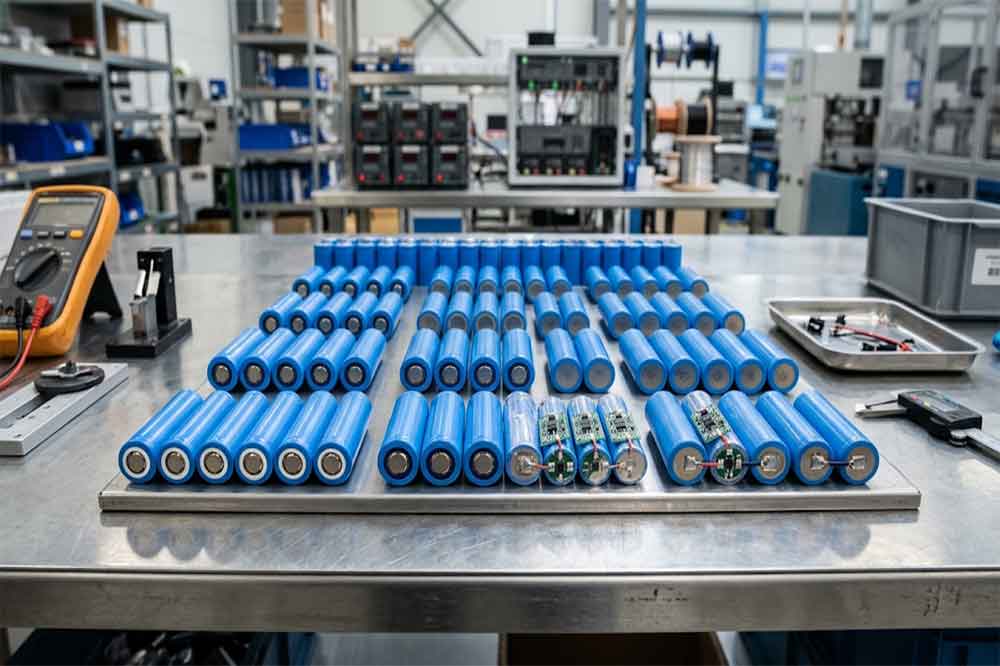
Buying protected 18650 batteries in bulk is not quite the same as ordering standard lithium-ion cells. A wholesale buyer needs to consider more than capacity and unit price. The protection circuit, cell consistency, physical dimensions, discharge requirements, and supplier’s production process all affect whether the batteries will work properly in the final equipment.
For distributors, importers, and equipment manufacturers, a small specification mistake can become an expensive problem when several thousand batteries have already been delivered.
Protected 18650 batteries are used in portable lighting, industrial equipment, backup power systems, electronic devices, and various customized battery applications. This guide explains what wholesale buyers should check before selecting a supplier and confirming a bulk order.
Explore our [18650 Lithium Battery Products] to find suitable cylindrical battery solutions for wholesale purchasing, equipment manufacturing, and customized battery projects.
What Are Wholesale Protected 18650 Batteries?
A protected 18650 battery is a cylindrical lithium-ion cell equipped with a protection circuit module (PCM) or battery protection board.
The circuit monitors the battery’s operating conditions and disconnects the output when certain electrical limits are exceeded.
Common protection functions include:
- Overcharge protection
- Over-discharge protection
- Overcurrent protection
- Short-circuit protection
The additional circuit makes the battery longer than a standard unprotected 18650 cell in many designs.
This difference matters when supplying batteries for equipment with a fixed battery compartment. A buyer who orders protected cells without checking their actual dimensions may discover that the batteries do not fit the original holder.
Protected vs. Unprotected 18650 Batteries
Unprotected 18650 cells are generally shorter and do not have an integrated protection circuit. They are commonly used in professionally designed battery packs where protection is handled by an external BMS.
Protected 18650 cells have individual protection electronics attached to the cell. They are often selected for applications that use individual replaceable batteries.
For wholesale buyers, neither option is automatically better. The correct choice depends on the equipment’s electrical design and safety requirements.

Identify Your Requirements Before Buying in Bulk
Before contacting a wholesale supplier, prepare a basic technical specification. This helps manufacturers provide a suitable quotation instead of offering a generic battery that may not match your application.
Voltage and Capacity
Most conventional 18650 lithium-ion batteries use a nominal voltage of 3.6V or 3.7V, with a full-charge voltage of 4.2V.
Capacity options vary according to cell chemistry, design, and manufacturer. Common commercial specifications include 2000mAh, 2200mAh, 2500mAh, 2600mAh, 3000mAh, and 3500mAh.
However, buyers should not assume that a higher capacity always means a better battery.
For example, a flashlight manufacturer may prioritize discharge performance and reliability over maximum capacity. A low-power electronic device may have different requirements.
The selected capacity should be supported by an actual cell specification and sample test results.
Protection Circuit Specifications
Ask the supplier to identify the protection board model or provide its technical specifications.
Important parameters include:
- Overcharge detection voltage
- Over-discharge detection voltage
- Overcurrent protection threshold
- Short-circuit protection response
- Operating current
These parameters should match the battery’s intended application.
Discharge Current
Discharge current is particularly important for equipment with motors, high-power LEDs, or other loads that require substantial current.
A battery rated for a high capacity may not necessarily support the required discharge current.
Buyers should provide both continuous operating current and peak current requirements. The supplier can then recommend an appropriate cell and protection circuit combination.
Dimensions and Compatibility
A standard unprotected 18650 cell is approximately 18mm in diameter and 65mm in length.
Protected versions may be longer because of the additional protection circuit and construction.
Confirm the maximum diameter and total length, including the positive terminal and protective components. Also specify whether the device requires a button-top or flat-top terminal.
These details are especially important for replacement battery programs and existing equipment designs.
Check Battery Cell Quality and Consistency
When purchasing a few batteries, individual performance differences may not seem significant. In a wholesale order, however, inconsistent cells can create problems for distributors and their customers.
Cell Grade and Manufacturing Source
Ask the supplier about the cell manufacturer, cell model, production batch, and quality inspection process.
A professional supplier should be able to explain where the cells come from and how incoming materials are checked.
Be cautious when a supplier offers unusually high capacity at a price significantly below the market level without providing a verifiable specification.
Capacity Consistency
Request capacity test records from samples or production batches.
The test conditions should be clearly defined, including:
- Charging voltage
- Charging current
- Discharge current
- Cutoff voltage
- Testing temperature
Comparing capacity figures without identical testing conditions can lead to misleading conclusions.
Internal Resistance
Internal resistance affects voltage drop and heat generation during operation.
For applications requiring higher current, buyers should pay particular attention to internal resistance consistency.
A supplier should be able to explain its measurement method and acceptance criteria rather than simply claiming that all batteries have low internal resistance.
Batch Consistency
For recurring wholesale orders, batch consistency is just as important as the initial sample quality.
Ask whether the supplier can maintain the same cell model, protection circuit configuration, and key electrical specifications across repeat orders.
If the original cell model becomes unavailable, the supplier should obtain approval before making a substitution.

Understand Protection Circuit Specifications
The protection board is one of the most important parts of a protected 18650 battery.
A low-cost protection circuit may reduce the purchase price, but it is not necessarily suitable for every application.
Overcharge Protection
Overcharge protection disconnects the charging path when the cell voltage exceeds the specified protection threshold.
This function helps prevent the cell from operating beyond its permitted charging voltage.
Over-Discharge Protection
Over-discharge protection disconnects the battery when its voltage falls below the specified threshold.
This helps reduce the risk of cell damage caused by excessive discharge.
Overcurrent and Short-Circuit Protection
When the connected equipment draws excessive current, the protection circuit interrupts the output according to its design.
However, protection thresholds must be selected carefully.
If the threshold is too low, normal equipment startup may trigger protection. If it is too high, the circuit may not provide the intended level of protection.
Wholesale buyers should provide the actual load characteristics when requesting a quotation.
What to Check When Evaluating a Wholesale Supplier
Choosing a supplier based only on the quoted price can create problems later, particularly when the order involves customized specifications or repeat shipments.
Manufacturing Capabilities
Ask whether the supplier manufactures protected batteries directly or purchases finished products from another source.
For customized orders, confirm whether the company can handle:
- Cell selection
- Protection board configuration
- Terminal customization
- PVC sleeve and labeling
- Battery dimension adjustments
- OEM packaging
A supplier with direct production and inspection capabilities can usually provide better control over specification changes.
Quality Control
Ask about incoming cell inspection, protection board testing, finished battery testing, and batch traceability.
Useful inspection records may include:
- Open-circuit voltage
- Capacity test results
- Internal resistance
- Protection function testing
- Physical dimension inspection
Do not assume that a supplier’s quality certification automatically guarantees every battery specification. Product-level testing is still necessary.
Certifications and Documentation
Depending on the product configuration and shipping destination, buyers may need documents such as:
- UN38.3 Test Summary
- MSDS
- CE documentation, where applicable
- RoHS documentation, where applicable
- ISO 9001 quality management certification
The required documentation should correspond to the actual battery model and shipment configuration.
For international transportation, confirm the applicable lithium battery packaging, labeling, and shipping requirements before placing the order.
OEM and ODM Services
For brands and equipment manufacturers, customization can be an important purchasing consideration.
A wholesale supplier should be able to discuss different cell capacities, protection board parameters, terminal designs, labels, and packaging.
If the battery is intended for a specific device, provide the equipment drawings or original battery sample whenever possible.
Samples, MOQ, Pricing, and Bulk Production
A good wholesale purchasing process should begin with technical confirmation and sample testing rather than immediately placing a large order.
Sample Testing
Request samples with the same specifications as the intended production order.
Test the batteries in the actual equipment, not just with a basic voltage meter.
Check whether:
- The battery fits the compartment.
- The device operates normally under load.
- The protection circuit responds correctly.
- Charging performance meets expectations.
- Battery dimensions and terminals are consistent.
For projects with special electrical requirements, additional testing may be necessary.
Minimum Order Quantity
MOQ varies depending on the battery model, protection circuit, packaging, and customization requirements.
Standard protected 18650 batteries may have different MOQ requirements from customized products.
Ask the supplier to separate standard-product MOQ from OEM customization MOQ.
Bulk Pricing Considerations
Wholesale pricing is affected by several factors:
- Cell brand and capacity.
- Protection circuit specifications.
- Order quantity.
- Custom terminals and packaging.
- Testing and certification requirements.
When comparing quotations, make sure all suppliers are quoting the same specifications.
A lower quotation may exclude certain testing, packaging, or documentation costs.
Lead Time and Production Planning
Confirm sample lead time, production lead time, and expected delivery schedule.
For repeat wholesale orders, discuss material availability and whether the supplier can reserve or plan cell inventory.
This is particularly important for distributors who need to maintain stock throughout the year.

Common Mistakes in Wholesale Protected 18650 Battery Orders
Several purchasing mistakes occur repeatedly in bulk battery sourcing.
Choosing by capacity alone
A 3500mAh battery is not automatically suitable for equipment that requires high discharge current. Cell performance must match the actual load.
Ignoring protection board specifications
Two batteries with identical voltage and capacity can have different protection thresholds. This can affect compatibility with the equipment.
Overlooking dimensions
Protected 18650 batteries may be longer or slightly different in diameter than standard cells. Always confirm the complete dimensions.
Skipping sample testing
A specification sheet cannot replace testing in the final device. Samples should be approved before mass production.
Failing to confirm repeat-order consistency
For distributors and OEM buyers, the second order should meet the same agreed specifications as the first. Establish this requirement before starting the business relationship.
How to Place a Reliable Wholesale Order
A practical purchasing process can reduce communication errors and avoid unnecessary production delays.
Step 1: Prepare the technical requirements.
Provide the required voltage, capacity, discharge current, dimensions, terminal type, and protection functions.
Step 2: Request a detailed quotation.
Ask the supplier to identify the cell model, protection board specifications, MOQ, sample cost, production lead time, and available documentation.
Step 3: Approve the samples.
Test the samples under actual operating conditions and confirm that the battery fits the equipment.
Step 4: Confirm the production specifications.
Keep an approved specification sheet or sample reference for the bulk order.
Step 5: Inspect before shipment.
Confirm the agreed inspection requirements, product labeling, packaging, and shipping documents.
This process is particularly useful when sourcing batteries from overseas manufacturers.
Custom Protected 18650 Batteries for OEM Projects
Standard protected 18650 batteries are suitable for many applications, but some projects require customized electrical or physical configurations.
For example, a portable lighting manufacturer may need a specific discharge current and button-top terminal. An industrial equipment manufacturer may require a particular battery length, wire connection, or protective sleeve.
A capable manufacturer should be able to evaluate these requirements before confirming production feasibility.
At Apsenx, we support B2B battery sourcing and OEM/ODM customization, including cell selection, protection circuit configuration, battery dimensions, terminal options, PVC sleeves, and product labeling.
We work with distributors, equipment manufacturers, and project buyers who need consistent battery specifications for commercial applications.
When requesting a quotation, provide your target capacity, voltage, discharge current, battery dimensions, estimated order quantity, and application details.
This gives the engineering and sales teams a clearer basis for recommending a suitable protected 18650 battery solution.
Contact Apsenx to discuss your wholesale protected 18650 battery requirements and OEM projects.
FAQ
Q1: What is the difference between protected and unprotected 18650 batteries?
Protected 18650 batteries include an integrated protection circuit that helps prevent overcharge, over-discharge, overcurrent, and short-circuit conditions. Unprotected cells rely on external protection systems.
Q2: Can I buy protected 18650 batteries in bulk with custom specifications?
Yes. Depending on the manufacturer’s capabilities, buyers can customize capacity, protection circuit parameters, terminal types, PVC sleeves, labels, and packaging.
Q3: What is the MOQ for wholesale protected 18650 batteries?
MOQ depends on the cell model, protection board, packaging, and customization requirements. Standard products and OEM products may have different minimum order quantities.
Q4: What documents should I request from a wholesale supplier?
Common documents include UN38.3 Test Summary, MSDS, applicable CE and RoHS documentation, and relevant quality management certificates. Requirements depend on the product and destination market.
Q5: Should I test samples before placing a bulk order?
Yes. Sample testing helps verify battery dimensions, capacity, discharge performance, charging behavior, and protection functions before mass production.
Related Articles
Before selecting a battery for bulk purchasing, it is important to understand its nominal voltage, full-charge voltage, and operating range. Read our guide to [protected 18650 battery voltage] for a closer look at these electrical specifications.
For applications with high-power loads, choosing the right discharge current is just as important as selecting battery capacity. Learn more about [protected 18650 battery discharge current] and how it affects battery selection.
Physical compatibility should be confirmed before placing a wholesale order, especially when protected cells are used in existing battery compartments. See our detailed guide to [protected 18650 battery dimensions] for measurements and design considerations.
Protected 18650 batteries are also used in industrial equipment where stable power delivery and reliable protection are important. Explore our guide to [industrial protected 18650 battery applications] to understand the requirements of different industrial devices.
When a project requires multiple cells connected together, the battery configuration becomes another important consideration. Our guide to [1S, 2S, 3S and 4S protected 18650 battery packs] explains the differences between common series configurations.
For equipment manufacturers planning customized battery solutions, understanding the assembly process can help clarify technical requirements before production. Read [how to build a protected 18650 battery pack for OEM applications] for more information about pack design and manufacturing considerations.
Before requesting an OEM quotation, prepare the key technical details of your battery project. Our article on [custom protected 18650 battery pack specifications] explains what information manufacturers need to evaluate a customization request.
Supplier selection is an important part of any wholesale purchasing decision. To compare manufacturers more effectively, read our guide on [what to check when choosing a protected 18650 battery pack manufacturer].
Related Products
-

12V 4400 mah Lithium ion 3S2P 18650 Battery Pack
-

18650 2000mAh 3.7 volt Lithium-ion Battery
-

18650 20V 3.0Ah Cordless Drill battery
-

18650 22.2V 7.8Ah 2600Mah 6S3P Rechargeable Battery Pack
-

18650 2600mAh Rechargeable Lithium-Ion Battery 3.7V
-

18650 3.7V 10Ah Li-Ion Power Battery Pack
-

18650 3.7V 3300mah Rechargeable Lithium ion Battery
-

18650 7S7P 24V 14Ah Lithium ion Electric Scooter Battery Pack
-

18650 battery 3.7V 1500mAh Lithium-Ion Battery
-

18650 Battery 3500 mah Rechargeable Battery Cells
-

18650 Electric Scooter 48V 13000mAh Lithium Battery
-

2600mAh 3S1P 11.1V 18650 Battery Packs
-

3.7V Li ion Rechargeable 3000mah 18650 Battery Cell
-

36V 5200mAh 10S2P 18650 Battery Pack
-

48v 4400mah 13S2P 18650 Rechargeable Battery Pack
-

7S2P 24V 18650 Lithium Battery Pack
-

Electric Scooter 36V 4400mAH 10S2P 18650 Battery Pack
-

ICR 18650 Battery 2200mah 3.7V
Leave a Reply