
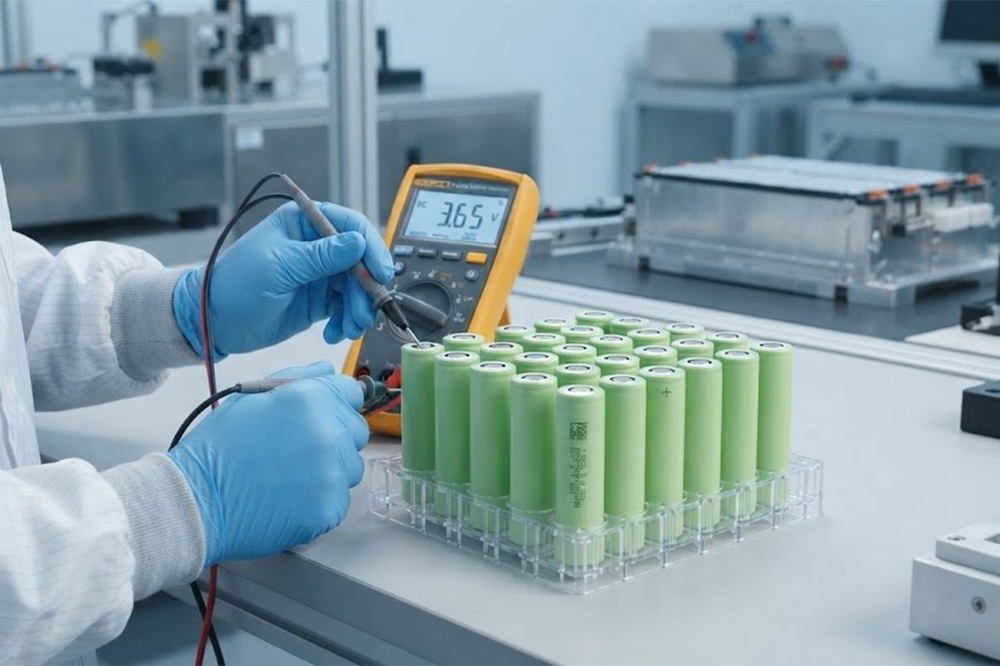
18650 batteries are widely used in electronics, power tools, e-bikes, robotics, and custom battery packs, but safe handling matters at every stage. This guide covers practical 18650 battery safety rules, from charging and storage to short-circuit prevention, physical inspection, BMS protection, and battery pack assembly.
Why 18650 Battery Safety Deserves Attention
18650 cell is small enough to fit between two fingers, which can make it look harmless.
It isn’t.
18650 lithium-ion cell can store a significant amount of energy in a compact package. Under normal conditions, it can work reliably for years. Problems usually appear when the cell is damaged, incorrectly charged, short-circuited, overheated, or used outside its intended specifications.
In real-world battery work, safety is rarely about one single component. The charger, cell, BMS, wiring, enclosure, temperature, and even the way the battery is stored can all affect the result.
For that reason, it is useful to think about 18650 safety as a complete process rather than simply asking whether a particular battery is “safe.”
1. Avoid Short Circuits
Short circuits are one of the most important risks to understand when handling loose 18650 cells.
The positive and negative terminals should never be allowed to directly contact each other or a conductive object.
For example, carrying loose cells in the same pocket as keys, coins, or metal tools creates an unnecessary risk. If a conductive object bridges the terminals, the cell can discharge a very large current in a short period.
This can cause:
- Rapid heating
- Damaged cell terminals
- Insulation damage
- Battery failure
- Potential thermal events
For loose cells, use protective cases or packaging that keeps the terminals separated.
This is particularly important for battery distributors and manufacturers moving large quantities of cells.
2. Do Not Ignore Damaged Battery Wrapping
The outer plastic wrap on an 18650 cell is not decorative packaging. It provides electrical insulation around the metal can.
A torn or damaged wrapper can expose conductive metal and increase the possibility of an accidental short circuit.
Before using a cell, look for:
- Torn wrapping
- Exposed metal
- Damaged positive terminal insulation
- Deep dents
- Corrosion
- Leakage
- Swelling
- Unusual discoloration
A small scratch may not automatically mean the cell is unusable, but exposed metal or significant physical damage should never be ignored.
If a cell looks questionable, separate it from normal inventory instead of putting it directly into a battery pack.

3. Use the Correct Charger
Charging is another area where mistakes can create problems.
18650 lithium-ion cell should be charged using a charger designed for the specific cell chemistry and configuration.
Do not assume that a charger designed for one battery type is automatically suitable for another.
single-cell lithium-ion battery, the charger must use an appropriate charging profile and voltage limit. For multi-cell battery packs, the charging requirements depend on the series configuration and battery management system.
For example, a pack made from cells connected in series requires more than simply connecting a high-voltage power supply to the pack.
If you’re working with multiple cells, our guide to 18650 series and parallel configuration explains how cell arrangement changes pack voltage and capacity.
4. Avoid Overcharging
Overcharging is one of the conditions that lithium-ion battery designers work hard to prevent.
A lithium-ion cell should not be charged beyond its specified voltage limit.
common 18650 lithium-ion cells, 4.2V is often associated with the full-charge voltage, but not every lithium-based cell uses exactly the same specifications. The actual charging limit should always come from the cell manufacturer’s datasheet.
This is why charger compatibility matters.
A proper battery management system can provide additional protection in a battery pack, but BMS protection should not be treated as a substitute for a properly designed charging system.
For a clearer explanation of the different voltage values, including 3.6V, 3.7V, and 4.2V, see our article on 18650 battery voltage.
5. Avoid Excessive Heat
Heat is another major factor in lithium battery safety.
18650 cell may become warm during high-current operation, especially in applications such as power tools, e-bikes, and high-power equipment.
Some temperature increase can be normal. Excessive or rapidly increasing temperature is different.
Possible causes include:
- Excessive discharge current
- High internal resistance
- Short circuits
- Poor electrical connections
- Incorrect charging
- Insufficient cooling
- Damaged cells
This is one reason high-drain applications need more careful cell selection.
Our guide to high-drain 18650 batteries explains why maximum current, continuous discharge capability, internal resistance, and voltage sag should all be considered together rather than choosing a cell based only on capacity.
6. Don’t Judge a Cell Only by Its mAh Rating
A common purchasing mistake is to compare 18650 cells only by capacity.
For example:
Cell A: 3000mAh
Cell B: 3500mAh
It might seem obvious that Cell B is better.
But what if the application needs high discharge current?
The higher-capacity cell may not necessarily be the better choice. Depending on the cell design, chemistry, internal resistance, and discharge characteristics, a lower-capacity high-drain cell may perform better in a demanding application.
Safety and performance often go together here.
Choosing the right cell means considering capacity, current, resistance, temperature, operating conditions, and expected cycle life.
7. Internal Resistance Is a Safety-Related Parameter
Internal resistance is sometimes treated as a technical specification that only engineers care about.
In practice, it can tell you a lot about how a cell behaves under load.
Higher internal resistance generally causes greater voltage drop and more heat generation when current flows.
For example, two cells may show almost identical open-circuit voltage but behave very differently when a heavy load is connected.
That is why resistance testing can be useful during quality control and battery pack assembly.
Our article 18650 battery internal resistance explained goes deeper into resistance testing, voltage sag, heating, aging, and cell matching.
8. Battery Packs Need a Proper BMS
When several 18650 cells are assembled into a battery pack, the safety requirements become more complicated.
properly designed battery management system, or BMS, can help monitor and control conditions such as:
- Overcharge
- Over-discharge
- Overcurrent
- Short circuit
- Cell imbalance
- Temperature
The exact BMS functions depend on the product design.
BMS also needs to match the battery configuration. A 3S pack, 5S pack, and 10S pack do not use the same series configuration requirements.
The BMS should be selected based on the number of series cells, operating current, charging requirements, chemistry, and application.
9. Don’t Mix Random 18650 Cells
Mixing cells from different models, capacities, ages, or manufacturers can create problems in a multi-cell battery pack.
Imagine assembling a pack with cells that have different:
- Capacities
- Internal resistance
- Discharge characteristics
- Ages
- State of charge
The cells may not behave evenly during charging and discharging.
professional battery production, cell matching is therefore an important step.
If you’re sourcing cells for OEM battery packs, don’t simply ask for “18650 batteries.” Provide the required capacity, current, dimensions, chemistry, and application requirements to the supplier.
10. Storage Is Part of Battery Safety
Battery safety does not stop when the battery leaves the charger.
Storage conditions matter too.
Avoid keeping 18650 cells in extremely hot or humid environments. Protect the terminals and keep loose cells away from conductive materials.
longer storage periods, maintaining an appropriate state of charge is generally preferable to leaving lithium-ion cells fully charged for months.
Our previous guide, how to store 18650 batteries properly, covers storage voltage, temperature, packaging, inspection, and warehouse inventory management in more detail.
This is especially useful for wholesalers that may hold thousands of cells before they are shipped to customers.
11. Test Used Cells Before Reuse
Used 18650 cells should not automatically go back into production simply because they still show voltage.
A cell showing 3.7V may still have reduced capacity or increased internal resistance.
Before reuse, consider checking:
- Physical condition
- Open-circuit voltage
- Internal resistance
- Actual capacity
- Load performance
- Temperature behavior
Our guide on how to test an 18650 battery provides a practical testing workflow that can be useful for both individual users and battery manufacturers.
12. Safe 18650 Battery Handling in Manufacturing
battery manufacturers safety needs to be built into the production process.
A basic workflow might include:
Incoming inspection → Cell testing → Cell matching → Pack assembly → BMS installation → Functional testing → Final inspection
The exact process depends on the product.
During assembly, avoid unnecessary mechanical damage to the cells. Welding parameters should be controlled, insulation should be properly installed, and the finished pack should be tested before shipment.
The enclosure also matters. A good battery pack needs mechanical protection, appropriate electrical insulation, and a design that manages heat under normal operating conditions.
Buying 18650 Batteries: Safety Questions to Ask a Supplier
If you’re purchasing 18650 cells for commercial production, asking the supplier a few basic questions can prevent problems later.
Consider asking:
- What is the exact cell model?
- What is the nominal voltage?
- What is the recommended charging voltage?
- What is the continuous discharge current?
- What is the typical capacity?
- What is the internal resistance?
- What certifications or test reports are available?
- How are cells packaged for shipment?
- Can different batches be identified?
- Can the supplier provide samples for testing?
For OEM projects, sample testing before a large purchase is usually much more useful than choosing a cell from a specification sheet alone.
You can also review available 18650 lithium battery models from Apsenx to compare capacity options for different applications.
Explore Apsenx 18650 Lithium Battery Products

A Practical 18650 Safety Checklist
Before using an 18650 cell:
- Check the wrapper.
- Check the terminals.
- Check the voltage.
- Look for dents or swelling.
- Confirm the cell specification.
- Use a compatible charger.
- Avoid short circuits.
- Avoid excessive heat.
- Do not mix random cells.
- Test questionable cells before use.
For battery manufacturers, add BMS verification, cell matching, pack testing, insulation inspection, and final quality control to the process.
Final Thoughts
18650 battery safety is not about making the battery complicated. It is mostly about avoiding situations that put unnecessary stress on the cell.
Use the correct charger. Protect the terminals. Don’t use damaged cells. Keep temperature under control. Match cells properly when building packs. And for commercial battery production, test the cells and the finished pack rather than relying on appearance alone.
For wholesalers and OEM buyers, safety starts even earlier—with choosing a suitable cell from a supplier that can provide consistent specifications and reliable batch quality.
A good 18650 battery is only part of a safe battery system. The charger, BMS, wiring, enclosure, thermal design, and manufacturing process all need to work together.
FAQs
1. Are 18650 batteries safe?
18650 lithium-ion cells can be safely used when they are properly specified, charged, stored, and handled. Damaged cells, short circuits, overcharging, excessive heat, and incorrect applications can create safety risks.
2. Can an 18650 battery explode?
A severely abused or damaged lithium-ion cell can experience a dangerous thermal event. Proper charging, protection, cell selection, and temperature management significantly reduce the risk.
3. Can I use a damaged 18650 battery?
A cell with a torn wrapper, exposed metal, swelling, leakage, severe dents, or other significant damage should not be treated as normal inventory. Separate questionable cells and follow appropriate battery handling procedures.
4. Do I need a BMS for an 18650 battery pack?
A properly designed BMS is commonly used for multi-cell lithium-ion battery packs to provide functions such as overcharge, over-discharge, overcurrent, and balancing protection. The BMS must match the pack configuration and application.
5. How can I make an 18650 battery pack safer?
Start with suitable cells, match cells correctly, use an appropriate BMS, control charging and discharge current, provide adequate insulation and mechanical protection, manage heat, and test the finished pack before use.
-

12V 4400 mah Lithium ion 3S2P 18650 Battery Pack
-

18650 2000mAh 3.7 volt Lithium-ion Battery
-

18650 20V 3.0Ah Cordless Drill battery
-

18650 22.2V 7.8Ah 2600Mah 6S3P Rechargeable Battery Pack
-

18650 2600mAh Rechargeable Lithium-Ion Battery 3.7V
-

18650 3.7V 10Ah Li-Ion Power Battery Pack
-

18650 3.7V 3300mah Rechargeable Lithium ion Battery
-

18650 7S7P 24V 14Ah Lithium ion Electric Scooter Battery Pack
-

18650 battery 3.7V 1500mAh Lithium-Ion Battery
-

18650 Battery 3500 mah Rechargeable Battery Cells
-

18650 Electric Scooter 48V 13000mAh Lithium Battery
-

2600mAh 3S1P 11.1V 18650 Battery Packs
-

3.7V Li ion Rechargeable 3000mah 18650 Battery Cell
-

36V 5200mAh 10S2P 18650 Battery Pack
-

48v 4400mah 13S2P 18650 Rechargeable Battery Pack
-

7S2P 24V 18650 Lithium Battery Pack
-

Electric Scooter 36V 4400mAH 10S2P 18650 Battery Pack
-

ICR 18650 Battery 2200mah 3.7V
Leave a Reply