
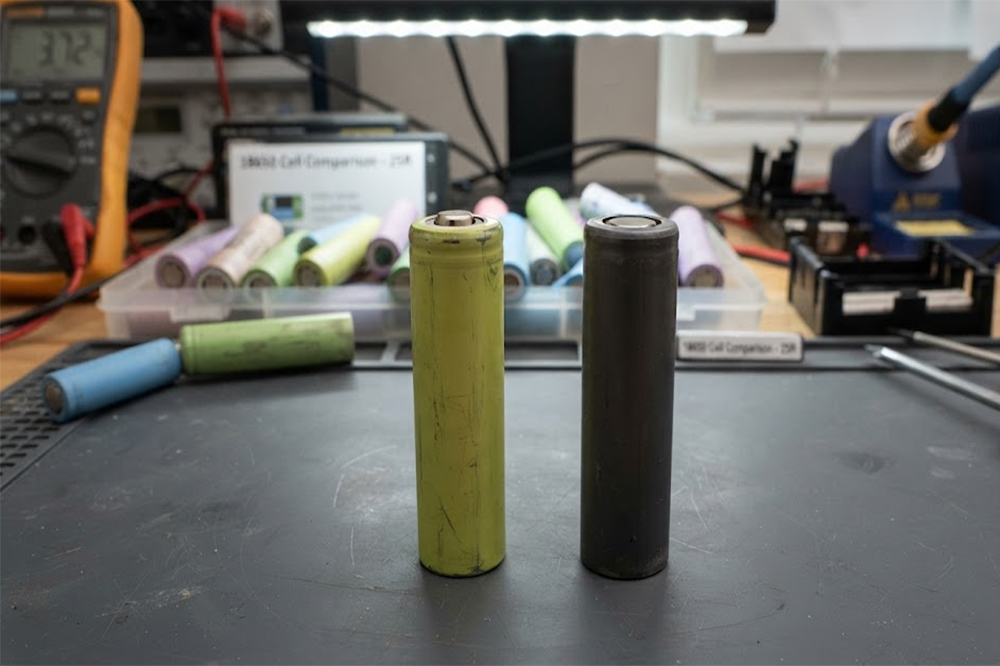
Button top and flat top 18650 batteries use the same basic cylindrical format, but their positive terminals are different. That small difference can determine whether a cell fits a device, makes proper contact, or works correctly in a custom battery pack.
Small Difference Can Cause a Big Problem
When ordering 18650 batteries for the first time, the specification list can look straightforward.
Capacity.
Voltage.
Discharge current.
Dimensions.
Then there is one small detail that is easy to overlook:
button top or flat top?
At first glance, it may seem like a minor physical difference. After all, both batteries are called 18650 cells and both are cylindrical lithium-ion batteries.
But if you put the wrong type into a battery holder, the device may not make proper electrical contact.
For a custom battery pack, the difference can affect the way cells are connected and welded.
I have seen this kind of specification get overlooked simply because the buyer focused on capacity and voltage first.
It is a good example of why an 18650 battery should be selected according to the actual application rather than just its basic cell name.
What Is Flat Top 18650 Battery?
A flat top 18650 has a relatively flat positive terminal.
The positive contact does not extend very far above the top surface of the cell.
This design is widely used in battery-pack manufacturing because cells can be arranged closely together and connected using appropriate welding methods or battery-pack components.
Flat top cells are common in applications where the battery is not intended to be installed directly into a consumer battery holder.
For example:
- Custom battery packs
- Power equipment
- Robotics
- Portable power systems
- Industrial electronics
- E-bike battery packs
- OEM battery assemblies
The exact terminal design can vary between manufacturers, so buyers should still confirm the actual cell drawing before production.
What Is Button Top 18650 Battery?
A button top 18650 has a small raised positive terminal.
It looks similar to the positive end of many traditional cylindrical batteries.
That raised terminal can make it easier for the cell to contact spring-loaded or mechanical battery holders designed for this type of terminal.
Button top cells are therefore commonly associated with devices where the user inserts individual batteries.
Examples can include certain:
- Flashlights
- Portable devices
- Battery-powered tools
- Electronic equipment
- Consumer products
But “button top” does not automatically mean that a cell will fit every device.
The height, diameter, terminal shape and overall construction still need to be checked.
Button Top vs. Flat Top at a Glance
| Feature | Button Top 18650 | Flat Top 18650 |
|---|---|---|
| Positive terminal | Raised | Relatively flat |
| Direct battery-holder use | Often convenient | Depends on holder |
| Overall length | Can be slightly longer | Usually more compact |
| Custom battery packs | Application dependent | Very common |
| Tight cell spacing | Less convenient in some designs | Often easier |
| Terminal contact | Raised contact point | Flat contact surface |
| OEM flexibility | Depends on equipment | Often preferred for pack assembly |
| Need to check dimensions | Yes | Yes |
This is a general comparison rather than a universal rule.
Different 18650 manufacturers use slightly different constructions, so always confirm the actual dimensions.

Why the Terminal Shape Matters
Imagine a flashlight designed with a spring contact at one end and a fixed contact at the other.
The battery holder expects the positive terminal to reach a certain position.
A button top cell may work perfectly.
A flat top cell might sit too far away from the contact.
The battery itself could be completely healthy.
The voltage could be correct.
The capacity could be correct.
And yet the flashlight still does not turn on.
That is why compatibility is not just about electrical specifications.
Mechanical compatibility matters too.
The same situation can happen in reverse if a device has very limited space and the extra height of a button top cell causes the battery compartment to close improperly.
Is Button Top 18650 Longer?
Often, yes.
The raised positive terminal can increase the overall length of the battery, although the actual difference depends on the cell design.
There may also be other components affecting total length.
For example, a protected 18650 battery can be longer because it includes a protection circuit.
This is worth remembering because button top and protected/unprotected are two different specifications.
A battery can be:
- Button top + protected
- Button top + unprotected
- Flat top + protected
- Flat top + unprotected
Not every combination is available for every cell model, but the concepts are separate.
If you are comparing protected and unprotected cells, our guide to protected vs. unprotected 18650 batteries explains how the protection circuit affects dimensions, current capability and battery-pack design.
Button Top Does Not Mean Protected
This misunderstanding comes up quite often.
Some buyers see a raised positive terminal and assume the battery must have a protection circuit.
That is not correct.
The raised terminal describes the physical terminal design.
Protection refers to the electrical protection system.
A button top cell can be unprotected.
A flat top cell can also have additional protection depending on how it is constructed.
So when ordering, do not simply tell a supplier:
“I need button top batteries.”
You may also need to specify:
- Protected or unprotected
- Capacity
- Discharge current
- Dimensions
- Terminal requirements
- Application
This avoids a lot of back-and-forth later.
Which One Is Better for Battery Packs?
For custom battery packs, there is no universal answer.
However, flat top cells are commonly used because the battery pack is designed around the cells and has its own electrical connection system.
Cells can be positioned closely and connected using nickel strips, busbars or other appropriate battery-pack assembly methods.
For a welded battery pack, the terminal design needs to match the intended assembly process.
This is particularly important when the battery manufacturer is producing thousands of packs.
A tiny dimensional difference that does not matter for one prototype can become a production issue when repeated across a large number of units.
What About Battery Holders?
Battery holders are where the difference becomes very obvious.
Many holders use:
- Springs
- Metal tabs
- Fixed contacts
- Sliding contacts
A button top battery may be easier to install in certain holders because the raised terminal provides a clear contact point.
A flat top cell may also work if the holder is designed for it.
The safest approach is simple:
Check the battery holder specification before selecting the cell.
If you are designing the product yourself, it is even better to choose the cell and holder together.
Do not finalize the battery first and discover during assembly that the terminal does not reach the contact.

Button Top vs. Flat Top for Flashlights
Flashlights are a good example because many of them use replaceable cylindrical batteries.
The flashlight’s battery compartment has a fixed length.
The contacts are positioned at specific locations.
A button top 18650 may work well if the flashlight was designed around that shape.
But some flashlights require a flat top cell.
Others may accept both.
There is no reliable rule such as “all flashlights need button tops.”
The manufacturer’s compatibility specification should be checked.
For a wholesale battery buyer supplying cells for consumer devices, testing the actual battery in the target equipment is a much safer approach than relying on the product name alone.
What About High-Drain 18650 Batteries?
Terminal shape does not determine whether an 18650 is high-drain.
This is another distinction worth keeping clear.
A high-drain cell is selected based on its electrical performance, including discharge capability, voltage behavior and internal characteristics.
The terminal shape is mainly a mechanical consideration.
If your application needs high current, start with the required continuous and peak current, then choose a suitable cell.
Our guide to high-drain 18650 batteries goes into more detail about current ratings, C rating, voltage sag and high-power applications.
This can be especially useful if you are selecting cells for power tools, robotics or other equipment that has a large startup current.
Don’t Forget Internal Resistance
The terminal shape is easy to see.
Internal resistance is not.
But for high-current applications, it can be much more important to the actual electrical performance of the battery.
Higher internal resistance can contribute to greater voltage drop and heat generation when current increases.
This is why a good cell-selection process looks at both mechanical and electrical specifications.
You need the battery to fit the product, but you also need it to perform inside the product.
If you want to understand this part in more detail, see our guide to 18650 battery internal resistance, which explains voltage sag, resistance testing, heat generation and cell matching.

Capacity Still Matters
Terminal shape should not distract from the main battery requirements.
A 3000mAh button top cell and a 3500mAh flat top cell are not automatically interchangeable simply because they share the 18650 format.
The capacity affects expected runtime.
The discharge capability affects power delivery.
The physical dimensions affect compatibility.
The terminal design affects electrical contact.
All four need to be considered together.
If you are comparing different capacities, our article on 18650 battery capacity, mAh, Ah and Wh explains how capacity relates to runtime and total battery energy.
That information becomes particularly useful when moving from individual cells to a complete battery pack.
A Simple OEM Example
Imagine a company developing a portable electronic device.
The first prototype uses a standard 18650 holder.
The engineering team selects a 3500mAh cell because they want longer runtime.
The cell specifications look perfect.
But during assembly, they discover that the positive terminal does not make reliable contact.
The problem is not capacity.
It is not voltage.
It is not battery chemistry.
It is simply the terminal design and mechanical compatibility.
A few samples would have exposed the problem immediately.
This is why sample testing is particularly valuable before placing a large OEM order.
What Should You Tell Your 18650 Supplier?
For a simple inquiry, I would provide more information than just “18650 3000mAh.”
A useful specification request might include:
Cell format: 18650
Capacity: 3000mAh
Terminal: Flat top
Protection: Unprotected
Application: Custom battery pack
Discharge requirement: Application dependent
Quantity: Required order volume
If you need a button top cell, say so clearly.
If the battery will be installed into an existing holder, provide the holder dimensions or product model whenever possible.
For custom battery-pack projects, providing a drawing or available installation space can make the supplier’s recommendation much more accurate.
How to Choose Between Button Top and Flat Top
A practical decision can be very simple.
Choose based on the equipment rather than the name.
For individual battery holders
Check whether the device specifically requires a button top or flat top.
For compact equipment
Pay close attention to the total cell length.
For custom battery packs
Check the welding and connection method before selecting the terminal design.
For high-current equipment
Focus first on discharge performance, internal resistance and thermal behavior.
For OEM production
Test samples in the actual product before confirming mass production.
That last step is easy to skip when everything looks correct on paper.
It is also one of the easiest ways to avoid a costly mistake.
Final Thoughts
Button top and flat top 18650 batteries are not different battery formats.
They are different terminal configurations within the same general 18650 cell family.
The difference may look small, but it can affect battery-holder compatibility, total dimensions, contact reliability and battery-pack assembly.
For individual consumer devices, the terminal shape can determine whether the battery fits and makes proper contact.
For OEM battery packs, the decision should be made together with the cell dimensions, welding method, BMS design and electrical requirements.
So when requesting an 18650 battery quotation, don’t just specify capacity and voltage.
Also specify the terminal type.
A few extra details at the quotation stage can save much more time during production.
FAQs
What is a button top 18650 battery?
A button top 18650 has a raised positive terminal. It is often used in devices with battery holders designed around a raised contact.
What is a flat top 18650 battery?
A flat top 18650 has a relatively flat positive terminal and is commonly used in custom battery packs and applications where cells are connected directly.
Can button top and flat top 18650 batteries be used interchangeably?
Not always. The device or battery holder must be designed to accommodate the specific terminal shape and overall cell dimensions.
Does button top mean the battery is protected?
No. Button top describes the physical terminal. Protection refers to an electrical protection circuit, so the two specifications should be considered separately.
Which is better for an OEM battery pack?
Flat top cells are commonly used in custom battery packs, but the correct choice depends on the pack design, connection method, BMS, available space and application requirements.
-

12V 4400 mah Lithium ion 3S2P 18650 Battery Pack
-

18650 2000mAh 3.7 volt Lithium-ion Battery
-

18650 20V 3.0Ah Cordless Drill battery
-

18650 22.2V 7.8Ah 2600Mah 6S3P Rechargeable Battery Pack
-

18650 2600mAh Rechargeable Lithium-Ion Battery 3.7V
-

18650 3.7V 10Ah Li-Ion Power Battery Pack
-

18650 3.7V 3300mah Rechargeable Lithium ion Battery
-

18650 7S7P 24V 14Ah Lithium ion Electric Scooter Battery Pack
-

18650 battery 3.7V 1500mAh Lithium-Ion Battery
-

18650 Battery 3500 mah Rechargeable Battery Cells
-

18650 Electric Scooter 48V 13000mAh Lithium Battery
-

2600mAh 3S1P 11.1V 18650 Battery Packs
-

3.7V Li ion Rechargeable 3000mah 18650 Battery Cell
-

36V 5200mAh 10S2P 18650 Battery Pack
-

48v 4400mah 13S2P 18650 Rechargeable Battery Pack
-

7S2P 24V 18650 Lithium Battery Pack
-

Electric Scooter 36V 4400mAH 10S2P 18650 Battery Pack
-

ICR 18650 Battery 2200mah 3.7V
Leave a Reply