
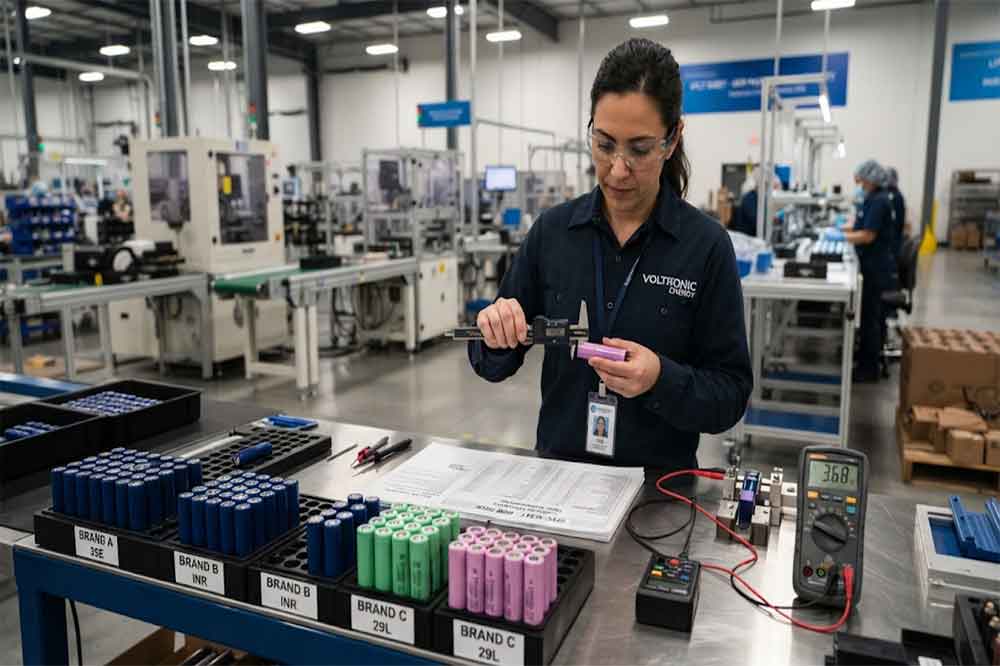
Choosing 18650 cell for OEM battery pack is not simply a matter of finding the highest capacity.
A battery pack may need high discharge current, long runtime, compact dimensions, stable performance, or a specific terminal design. In real OEM projects, the cell has to match the application, pack configuration, BMS, mechanical space, thermal design, and production requirements at the same time.
That is why cell selection should happen before the battery pack design is finalized.
This guide explains how to choose standard 18650 cells for OEM battery packs and what battery buyers, engineers, and procurement teams should check before placing a bulk order.
1. Start With the Application
The application should determine the cell selection.
A flashlight, portable medical device, industrial instrument, power tool, and e-bike battery pack may all use 18650 cells, but their requirements can be very different.
For example, a portable electronic device may prioritize capacity and compact size. A power tool can place much more emphasis on discharge current and temperature rise.
Before selecting the cell, define:
- Required pack voltage
- Required capacity
- Continuous discharge current
- Peak discharge current
- Expected runtime
- Available installation space
- Operating temperature
- Charging requirements
- Expected cycle life
- Pack weight limitations
This information provides the starting point for selecting an appropriate 18650 cell.
2. Check the Nominal Voltage First
Most standard 18650 lithium-ion cells used in OEM packs have a nominal voltage around 3.6V or 3.7V, depending on the cell chemistry and manufacturer’s specification.
The fully charged voltage is commonly around 4.2V for conventional lithium-ion cells.
The important point is that the pack voltage is determined by the number of cells connected in series.
For example:
| Configuration | Nominal Voltage | Maximum Voltage |
|---|---|---|
| 5S | 18.0–18.5V | 21.0V |
| 7S | 25.2–25.9V | 29.4V |
| 10S | 36.0–37.0V | 42.0V |
| 13S | 46.8–48.1V | 54.6V |
| 14S | 50.4–51.8V | 58.8V |
The exact values depend on the cell specification and the nominal voltage used by the manufacturer.
For a deeper explanation of series and parallel design, see 18650 Battery Series and Parallel: Understanding S and P Configurations.
3. Choose Capacity Based on the Real Requirement
Capacity is usually specified in mAh or Ah.
Common 18650 capacities may include 2000mAh, 2500mAh, 2600mAh, 3000mAh, 3200mAh, and 3500mAh, although available specifications vary by cell model.
A higher-capacity cell can provide more energy from the same number of cells. But capacity should not be considered alone.
Suppose an OEM project needs approximately 12Ah.
Using a 3000mAh cell:
3000mAh × 4 = 12,000mAh
So four cells in parallel can provide approximately 12Ah.
Using a 3500mAh cell:
3500mAh × 4 = 14,000mAh
The second option provides more capacity with the same parallel count, but that does not automatically make it the better choice. The cell’s discharge capability, internal resistance, dimensions, price, availability, and production consistency also matter.
For a detailed capacity comparison, see Standard 18650 Battery Capacity: 2000mAh, 2600mAh, 3000mAh or 3500mAh?
4. Capacity and Discharge Current Are Different
This is one of the most important points when selecting OEM 18650 cells.
A high-capacity cell is not necessarily a high-discharge cell.
A cell designed around high energy density may have a different discharge specification from a cell designed for high-power applications.
Consider two simplified choices:
| Cell Type | Capacity | Discharge Requirement |
|---|---|---|
| High-capacity cell | 3500mAh | Moderate current |
| High-discharge cell | 2500–3000mAh | Higher current |
For equipment that operates at relatively low current for a long period, a higher-capacity cell may be suitable.
For a power tool, motor system, or other high-load application, discharge capability can become more important than maximum capacity.
The final selection should always be based on the manufacturer’s actual continuous and pulse discharge specifications rather than capacity alone.
For more detail, see High Capacity vs High Discharge 18650 Batteries and 18650 Battery Discharge Current: What Buyers Should Check.

5. Calculate the Required Pack Current
The cell must support the current required by the complete battery pack.
For a simplified parallel configuration:
Pack current capability ≈ cell current capability × number of cells in parallel
For example, suppose a cell is rated for 10A continuous discharge and the pack uses four cells in parallel:
10A × 4 = approximately 40A
This is only a simplified calculation.
Real pack design also depends on temperature, cell aging, BMS current limits, nickel or busbar design, connection resistance, enclosure cooling, and the manufacturer’s discharge conditions.
A battery manufacturer should therefore verify the complete system rather than selecting cells from a single current number.
6. Check Energy, Not Just Ah
Capacity tells you how much charge the battery stores. Energy gives a more useful picture of how much work the battery can provide.
A simple calculation is:
Energy (Wh) ≈ Nominal Voltage (V) × Capacity (Ah)
For example:
36V × 12Ah ≈ 432Wh
The actual usable energy can be lower because of discharge conditions, cutoff voltage, temperature, load profile, aging, and other system factors.
This is particularly important for OEM projects where the customer has a target runtime or energy requirement.
For a more detailed explanation, see How Much Energy Does an 18650 Battery Hold? A Simple Wh Guide.
7. Check the Physical Dimensions
Electrical specifications are only half of the selection process.
The cell must physically fit inside the battery pack.
The term “18650” describes the approximate cylindrical cell size, but manufacturers can have differences in actual dimensions, terminals, insulation, and construction.
A typical 18650 cell is approximately 18mm in diameter and 65mm long, but the complete installed dimensions need to be confirmed from the cell datasheet.
Check:
- Cell diameter
- Cell length
- Positive terminal design
- Flat top or button top
- Insulation sleeve
- Cell holder requirements
- Welding area
- Pack enclosure dimensions
A few millimeters can matter when dozens of cells are arranged inside a compact enclosure.
For this reason, OEM buyers should provide drawings or dimensional restrictions whenever possible.
See 18650 Battery Dimensions: What Does 18650 Really Mean? for more information.

8. Flat Top or Button Top?
Terminal design can affect the mechanical and electrical design of an OEM pack.
Flat-top cells have a relatively flat positive terminal and are commonly used in battery packs with dedicated interconnection structures.
Button-top cells have a raised positive terminal and are frequently found in applications where direct device contact is expected.
For an OEM battery pack, the important question is not simply which type is more common.
The question is:
Which terminal design matches the pack structure and connection method?
Check the battery holder, nickel strip, busbar, spot-welding process, insulation structure, and available space before confirming the cell.
For a detailed comparison, see Flat Top vs Button Top 18650 Batteries: What’s the Difference?
9. Internal Resistance Matters
Internal resistance affects voltage drop, heat generation, and load performance.
When current flows through a cell, resistance causes power loss:
Power loss ≈ I² × R
This means that resistance becomes increasingly important as current increases.
For example, a cell with higher internal resistance may experience more voltage sag under heavy load and generate more heat.
OEM buyers should therefore ask suppliers about:
- DC internal resistance
- Testing method
- Test temperature
- Testing state of charge
- Capacity test conditions
- Production batch consistency
Internal resistance should not be compared blindly between suppliers. The measurement method needs to be consistent.
10. Cell Matching Is Critical for Pack Production
Using cells with the same nominal capacity does not necessarily mean the cells are perfectly matched.
For multi-cell battery packs, manufacturers may need to control differences in:
- Capacity
- Internal resistance
- Voltage
- Self-discharge behavior
- Production batch
- Cell age
Good matching helps the cells behave more consistently during charging and discharging.
This becomes especially important for larger packs containing many cells.
For example, a 13S4P pack contains:
13 × 4 = 52 cells
The more cells a pack contains, the more important production consistency becomes.

11. Consider High-Capacity vs High-Discharge Cells
There is often a trade-off between energy density and power capability.
A high-capacity cell can help reduce the number of parallel cells needed for a target Ah rating.
A high-discharge cell may be more appropriate when the application requires high current.
The correct choice depends on the application.
High-capacity cells may suit:
- Portable electronics
- Long-runtime equipment
- Backup power
- Moderate-load industrial devices
High-discharge cells may suit:
- Power tools
- Motor-driven equipment
- High-current devices
- Applications with short periods of heavy load
This is a design decision, not simply a specification comparison.
12. Think About Temperature and Thermal Design
Battery cells generate heat during charging and discharging.
Heat generation can increase with current and internal resistance.
For a compact OEM battery pack, there may be limited space for heat dissipation. Cell selection should therefore be considered together with the enclosure, airflow, insulation, BMS settings, and expected operating environment.
Ask the battery manufacturer to evaluate:
- Maximum operating temperature
- Charging temperature range
- Discharging temperature range
- Expected temperature rise
- Pack ventilation
- Thermal insulation
- Continuous and peak load conditions
A cell that performs well in a laboratory test may behave differently inside a tightly packed enclosure.
13. Match the Cell With the BMS
The BMS is part of the complete battery system.
The selected cell and BMS should work together in terms of:
- Number of series cells
- Overcharge protection
- Over-discharge protection
- Over-current protection
- Short-circuit protection
- Temperature monitoring
- Balancing strategy
- Continuous current rating
For example, a 10S pack requires a BMS designed for a 10-series configuration.
The BMS cannot compensate for an unsuitable cell.
Cell selection, BMS design, interconnection, charging, and thermal management should be treated as one system.
14. Check the Cell’s Production Consistency
OEM production is different from buying a few cells for testing.
A prototype may require only dozens of cells, while mass production may require thousands or more.
The cell supplier should therefore be able to provide stable specifications across production batches.
Important information can include:
- Cell model
- Nominal capacity
- Nominal voltage
- Discharge rating
- Internal resistance
- Dimensions
- Production date or batch information
- Test report
- Datasheet
- Safety documentation
For long-term OEM projects, consistency between the approved sample and later production batches is especially important.
15. Do Not Select a Cell From the Datasheet Alone
Datasheets are necessary, but prototype testing is still important.
A practical OEM evaluation can include:
- Capacity testing
- Internal resistance testing
- Discharge testing
- Charging testing
- Temperature monitoring
- Physical dimension verification
- Pack assembly testing
- BMS compatibility testing
- Runtime testing
- Aging or cycle testing where required
The goal is to verify that the selected cell works in the actual battery design.
A cell that looks suitable on paper may require a different configuration after prototype testing.
16. Consider Supply Stability Before Mass Production
A good cell for an OEM project also needs to be available consistently.
Changing the cell model after the battery pack has entered production can affect:
- Pack dimensions
- Capacity
- Current performance
- BMS settings
- Mechanical design
- Certification
- Production processes
- Product documentation
For this reason, procurement teams should discuss expected annual volume and production schedule with the battery supplier before finalizing the cell model.
A cell that is suitable for a prototype but difficult to source later can create problems for the finished product.
17. What Should OEM Buyers Send to a Battery Manufacturer?
A clear RFQ makes cell selection much faster.
Instead of asking only for “18650 battery cells,” provide the main technical requirements.
A useful OEM inquiry can include:
Application: industrial equipment / power tool / portable electronics / e-bike / other
Target voltage: for example, 36V or 48V class
Target capacity: for example, 10Ah or 20Ah
Maximum continuous current: for example, 20A
Peak current: if applicable
Maximum dimensions: length × width × height
Expected annual quantity: estimated units per year
Cell preference: high capacity / high discharge / open to recommendation
BMS: required or customer supplied
Connector: required type
Certification: required market or product standard
Sample quantity: number of prototype packs
Production target: expected mass-production date
A drawing, existing battery photo, or old battery specification can make the discussion even clearer.
18. Common Cell Selection Mistakes
Choosing the highest mAh number
Maximum capacity is not always the correct specification.
The application may require much higher discharge capability.
Ignoring internal resistance
Resistance can affect voltage sag and heat, especially under heavy loads.
Checking only one sample
One good sample does not prove production consistency.
Ignoring dimensions
A cell that cannot fit the enclosure is not a practical OEM choice.
Mixing different cell models
Mixing cells with different characteristics can create inconsistent pack behavior.
Selecting the BMS later
The BMS should be considered during pack design, not added as an afterthought.
Focusing only on the cell price
For OEM projects, the total cost also includes pack construction, BMS, connectors, testing, certification, assembly, logistics, and possible redesign costs.
19. A Simple OEM Cell Selection Process
The selection process can be simplified into seven steps:
Application → Electrical requirements → Cell specifications → Physical design → Prototype testing → Production validation → Bulk supply
This approach prevents a common problem: selecting a cell first and trying to make the rest of the battery pack fit around it.
For OEM battery manufacturing, the better approach is to define the system requirements first and then select the cell.
20. Final Checklist for Choosing 18650 Cells
Before approving an 18650 cell for an OEM battery pack, check:
- Nominal voltage
- Full-charge voltage
- Capacity
- Continuous discharge current
- Peak discharge current
- Internal resistance
- Dimensions
- Terminal type
- Cell chemistry
- Operating temperature
- Charging temperature
- Cell matching requirements
- BMS compatibility
- Pack configuration
- Production consistency
- Testing documentation
- Supply availability
- Sample performance
- Mass-production requirements
The “best” 18650 cell is not simply the cell with the largest capacity or highest current rating.
It is the cell whose electrical, mechanical, thermal, and supply characteristics match the complete battery pack.
For OEM buyers, that means cell selection should be made together with pack configuration, BMS design, mechanical structure, testing, and production planning.
Once these requirements are clear, an experienced battery manufacturer can recommend a suitable 18650 cell and build the pack around the actual application.
-

12V 4400 mah Lithium ion 3S2P 18650 Battery Pack
-

18650 2000mAh 3.7 volt Lithium-ion Battery
-

18650 20V 3.0Ah Cordless Drill battery
-

18650 22.2V 7.8Ah 2600Mah 6S3P Rechargeable Battery Pack
-

18650 2600mAh Rechargeable Lithium-Ion Battery 3.7V
-

18650 3.7V 10Ah Li-Ion Power Battery Pack
-

18650 3.7V 3300mah Rechargeable Lithium ion Battery
-

18650 7S7P 24V 14Ah Lithium ion Electric Scooter Battery Pack
-

18650 battery 3.7V 1500mAh Lithium-Ion Battery
-

18650 Battery 3500 mah Rechargeable Battery Cells
-

18650 Electric Scooter 48V 13000mAh Lithium Battery
-

2600mAh 3S1P 11.1V 18650 Battery Packs
-

3.7V Li ion Rechargeable 3000mah 18650 Battery Cell
-

36V 5200mAh 10S2P 18650 Battery Pack
-

48v 4400mah 13S2P 18650 Rechargeable Battery Pack
-

7S2P 24V 18650 Lithium Battery Pack
-

Electric Scooter 36V 4400mAH 10S2P 18650 Battery Pack
-

ICR 18650 Battery 2200mah 3.7V
Leave a Reply