
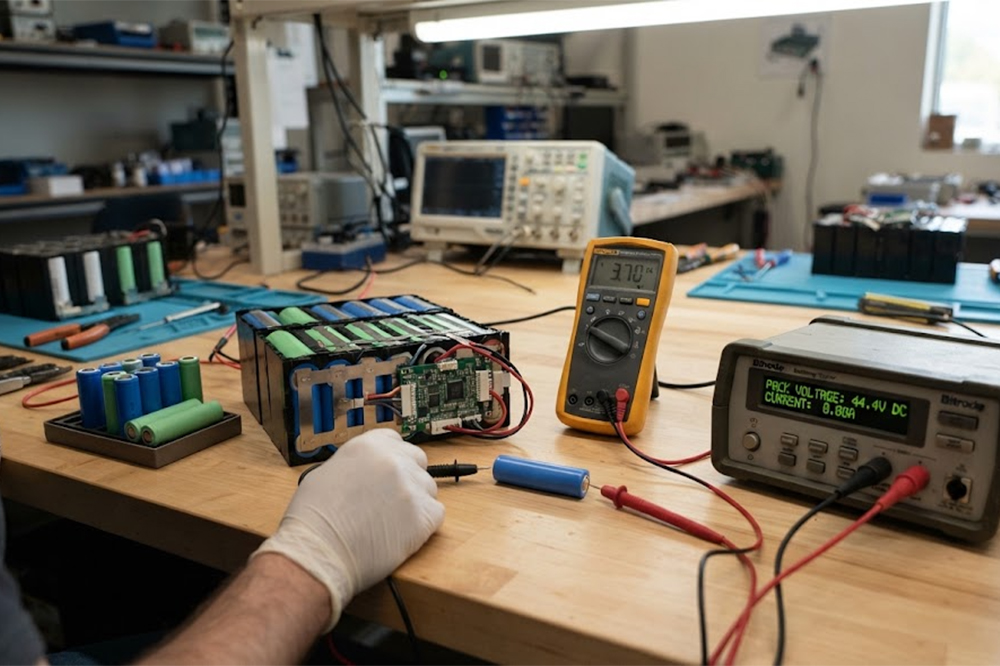
A standard 18650 lithium-ion cell is commonly described as 3.6V or 3.7V, but that is its nominal voltage rather than its maximum voltage. The actual voltage changes during charging and discharging, and the final battery-pack voltage depends mainly on the number of cells connected in series.
For OEM buyers, understanding these voltage differences is important when choosing cells, designing a BMS and matching the battery to the equipment and charger.
Why Does 18650 Say 3.6V or 3.7V?
If you’ve ever compared 18650 lithium-ion cells, you may have noticed something slightly confusing.
One supplier lists:
3.6V
Another lists:
3.7V
Both may be selling standard lithium-ion 18650 cells.
So which one is correct?
In many cases, the difference is simply how the manufacturer defines and presents the nominal voltage.
A conventional lithium-ion 18650 cell commonly operates around this nominal voltage range, while its voltage during actual use moves considerably above and below that value.
For practical battery-pack calculations, 3.6V or 3.7V nominal may therefore appear depending on the cell specification.
The important number isn’t only the nominal voltage.
You also need to know:
Maximum charge voltage
Discharge cutoff voltage
Nominal voltage
These three numbers tell you much more about how the cell behaves inside a real battery.
What Is the Nominal Voltage of an 18650?
The nominal voltage is a convenient reference value.
It is not the voltage you will measure from the cell at every moment.
For many conventional lithium-ion 18650 cells, you will see:
3.6V nominal
or
3.7V nominal
This value is used when calculating battery-pack specifications and energy.
For example:
3.7V × 3Ah = 11.1Wh
This doesn’t mean the cell stays at exactly 3.7V throughout its discharge.
In actual use, the voltage gradually changes.
That’s why a battery-powered device doesn’t simply receive a perfectly constant 3.7V from a single 18650 cell.

What Is the Full-Charge Voltage?
For many standard lithium-ion 18650 cells, the maximum charging voltage is:
4.2V
This is significantly higher than the nominal 3.6V or 3.7V figure.
So a single cell may be described as:
3.7V nominal
4.2V full charge
There is no contradiction here.
The battery operates across a voltage range.
When the cell is fully charged, its terminal voltage can reach approximately 4.2V under the specified charging conditions.
The exact maximum voltage should always come from the cell manufacturer’s datasheet.
Different lithium-ion chemistries can have different voltage characteristics, so it is not safe to assume that every cylindrical lithium cell uses exactly the same charging voltage.
Why Does Battery Voltage Drop During Use?
As the cell discharges, its voltage decreases.
The actual discharge curve isn’t a perfectly straight line.
There can be a relatively stable voltage region followed by a more noticeable decline as the cell approaches its lower voltage limit.
The exact curve depends on:
- Cell chemistry
- Discharge current
- Temperature
- Cell age
- Internal resistance
- Cutoff voltage
This is particularly noticeable in high-current applications.
Imagine a power tool starting its motor.
The cell voltage may temporarily drop because of the high current demand and internal resistance.
The battery may still have considerable capacity remaining, but the device can see a lower instantaneous voltage.
This is one reason engineers look at both capacity and discharge performance when selecting an 18650 cell.
What Is the Discharge Cutoff Voltage?
The cutoff voltage is the lower voltage limit used during discharge.
A typical lithium-ion cell may have a cutoff around:
2.5V–3.0V
depending on the cell specification and application.
But this is not a universal number.
You should always follow the actual manufacturer’s datasheet.
The cutoff voltage affects usable capacity.
If you stop the discharge earlier, you may leave some energy unused.
If you discharge too far, you can damage the cell and create safety concerns.
This is one of the jobs handled by the battery-management system in a properly designed multi-cell battery pack.

How Does 18650 Series Connection Change Voltage?
This is probably the most important calculation when designing a battery pack.
When cells are connected in series, their voltages add together.
For a typical 3.7V nominal cell:
1S = 3.7V
2S = 7.4V
3S = 11.1V
4S = 14.8V
5S = 18.5V
6S = 22.2V
7S = 25.9V
8S = 29.6V
10S = 37V
13S = 48.1V
15S = 55.5V
These are nominal voltages.
If the cell has a 4.2V maximum charge voltage, the full-charge voltage is:
Series count × 4.2V
So:
4S = 16.8V full charge
10S = 42V full charge
15S = 63V full charge
This distinction becomes very important when choosing the charger.
18650 Battery Voltage Chart
| Configuration | Nominal Voltage* | Full Charge* |
|---|---|---|
| 1S | 3.7V | 4.2V |
| 2S | 7.4V | 8.4V |
| 3S | 11.1V | 12.6V |
| 4S | 14.8V | 16.8V |
| 5S | 18.5V | 21.0V |
| 6S | 22.2V | 25.2V |
| 7S | 25.9V | 29.4V |
| 8S | 29.6V | 33.6V |
| 10S | 37.0V | 42.0V |
| 13S | 48.1V | 54.6V |
| 15S | 55.5V | 63.0V |
*Typical values based on a 3.7V nominal, 4.2V maximum-charge lithium-ion cell. Actual specifications depend on the selected cell.
This chart is useful when you are doing an initial battery design.
For the final specification, however, use the exact cell datasheet.

Does Parallel Connection Increase Voltage?
No.
Parallel connection primarily increases capacity and current capability while keeping the nominal voltage approximately the same.
For example:
4S1P
and
4S2P
both have approximately:
14.8V nominal
The difference is capacity.
If each cell is 3000mAh:
4S1P = 3Ah
4S2P = 6Ah
4S3P = 9Ah
The voltage remains approximately 14.8V.
This is why the S/P notation is so useful.
S tells you the voltage configuration.
P tells you the parallel capacity.
What Does 10S2P Mean?
Let’s take a practical example.
A customer asks for:
10S2P 18650 battery
This means:
10 series groups
2 cells in parallel per group
Total cell count:
10 × 2 = 20 cells
Using 3000mAh cells:
Nominal voltage:
10 × 3.7V = 37V
Capacity:
2 × 3Ah = 6Ah
Full-charge voltage:
10 × 4.2V = 42V
Nominal energy:
37V × 6Ah = 222Wh
Now the battery specification starts to make sense.
Instead of saying “20 pieces of 3000mAh cells,” the finished battery can be described as approximately:
37V 6Ah / 222Wh
This is much easier for an equipment manufacturer to use.
What About a 15S Battery?
15S configurations are also used in higher-voltage applications.
Using a typical 3.7V nominal cell:
15 × 3.7V = 55.5V
At full charge:
15 × 4.2V = 63V
So a 15S lithium-ion battery may be specified approximately as:
55.5V nominal
63V full charge
If you are developing a 15S battery, the charger and BMS need to be designed around this voltage range.
This is particularly important for equipment with a nominal voltage around 48V–56V.
Why Is “48V Battery” Sometimes Confusing?
You’ll often see batteries described commercially as:
48V battery
But the actual lithium-ion pack may have a nominal voltage of:
48.1V
if it uses a 13S configuration with 3.7V cells.
Its maximum charge voltage would be:
54.6V
This is why product names and electrical specifications are not always identical.
The same issue appears with other nominal battery classes.
A product may be marketed as “24V,” while its actual lithium-ion pack voltage can be around 22.2V nominal for a 6S configuration.
For engineering work, use the actual cell and pack voltage rather than relying only on the marketing name.
Why Voltage Matters When Choosing a BMS
The BMS must match the number of series cells.
A:
4S battery
needs a BMS designed for 4S.
A:
10S battery
needs a BMS designed for 10S.
A:
15S battery
needs a 15S-compatible BMS.
This sounds obvious, but it becomes important when a customer changes the battery configuration during development.
If the original prototype was 10S and the final product moves to 13S, the BMS, charger and possibly the system electronics need to be reviewed.
Voltage isn’t an isolated specification.
It affects several parts of the product.
Voltage and Charger Selection
The charger needs to match the battery’s charging voltage.
For a typical:
4S lithium-ion battery
the full-charge voltage is:
16.8V
For:
10S
it is:
42V
For:
15S
it is:
63V
So selecting a charger based only on the battery’s marketing name can be risky.
A customer may say:
“I need a 48V charger.”
The next question should be:
What is the actual battery configuration and full-charge voltage?
If it is a 13S lithium-ion pack, the charger normally needs to be designed around 54.6V maximum charging voltage.
Our article on [18650 battery charging] covers charger selection, CC/CV charging and charging current in more detail.
Voltage Drop Under Load
Another issue that doesn’t show up in a simple battery specification is voltage sag.
Suppose an 18650 cell is sitting at:
3.8V
Then a device suddenly draws a high current.
The measured voltage might temporarily drop.
Part of this comes from the cell’s internal resistance.
The relationship is roughly:
Voltage drop = Current × Internal Resistance
So if current increases, voltage drop increases too.
This is particularly important for:
- Power tools
- Robotics
- Motors
- Portable industrial equipment
- High-power electronics
A battery can have plenty of capacity but still perform poorly if the cell cannot handle the required current.
That is why high-drain applications need a different cell-selection approach.
Does Temperature Affect 18650 Voltage?
Yes.
Temperature can influence internal resistance, available capacity and voltage behavior.
At low temperatures, the cell may show greater voltage drop under load.
At high temperatures, chemical reactions inside the cell can accelerate aging.
This is another reason why a battery that performs well in a room-temperature test may behave differently outdoors.
If your battery will be used in a warehouse, vehicle, outdoor cabinet or industrial environment, provide the expected operating temperature when requesting a quotation.
The battery supplier can then select a cell based on the actual conditions rather than a laboratory-only scenario.
Can I Replace 3.6V 18650 With a 3.7V 18650?
Not automatically.
The difference between 3.6V and 3.7V nominal ratings may sometimes come from how manufacturers specify the same general lithium-ion voltage range.
But you still need to check the actual:
- Chemistry
- Maximum charge voltage
- Discharge cutoff
- Capacity
- Discharge current
- Physical dimensions
If the original cell is part of an existing battery pack, replacing it without checking these specifications isn’t a good idea.
For an OEM product, the exact cell model should ideally be defined before mass production.
Does Higher Voltage Mean More Battery Energy?
Not by itself.
Energy depends on both voltage and capacity:
Wh = V × Ah
For example:
37V × 6Ah = 222Wh
Another battery:
18.5V × 12Ah = 222Wh
The two batteries have the same nominal energy in this simplified example.
The first has higher voltage and lower Ah.
The second has lower voltage and higher Ah.
This is why Wh is often a better number when comparing the total energy of batteries with different voltage configurations.
For more details, see our article on [18650 battery capacity, mAh, Ah and Wh].
A Practical OEM Example
Suppose a customer is developing an industrial device that requires approximately:
55V nominal
and:
5Ah
A possible configuration using standard 3.7V cells is:
15S2P
with 2500mAh cells.
Nominal voltage:
15 × 3.7V = 55.5V
Capacity:
2 × 2.5Ah = 5Ah
Full charge:
15 × 4.2V = 63V
Nominal energy:
55.5V × 5Ah = 277.5Wh
Now the engineer has a useful starting point.
The next questions are about discharge current, battery dimensions, BMS, charger, connector and expected cycle life.
This is how a simple “55V battery” request turns into a real battery specification.
What Voltage Information Should You Give a Battery Manufacturer?
If you’re requesting an OEM quotation, don’t only write:
“Need 48V 18650 battery.”
Instead, provide as much information as you know:
Nominal voltage
Full-charge voltage
Capacity
Continuous current
Peak current
Maximum dimensions
Application
Charging requirements
Quantity
If you don’t know the exact S/P configuration, that’s okay.
For example, you can simply say:
“We need approximately 48V, 10Ah, maximum discharge 20A, battery size within 100 × 80 × 150mm.”
A battery manufacturer can then work backward and suggest an appropriate cell configuration.
Don’t Design the Battery Around One Number
This is probably the biggest point worth remembering.
A battery isn’t simply:
Voltage + mAh
The finished system also needs to work with the charger, BMS and load.
For example:
A higher voltage may reduce current for the same power output.
A higher capacity may increase runtime but also increase battery size and cost.
A high-drain cell may perform better under heavy loads but may offer less capacity than another cell of the same physical format.
So there is usually some compromise.
That’s normal battery engineering.
Choosing the Right 18650 Voltage for OEM Projects
If you’re developing a new product, start with the equipment requirements.
Determine the operating voltage range.
Then determine the required energy and current.
After that, the series and parallel configuration can be selected.
For example:
Voltage requirement → Series count
Capacity requirement → Parallel count
Current requirement → Cell selection + parallel count
Runtime requirement → Total Wh
Protection → BMS
Charging → Charger
This approach is much more reliable than starting with a random 18650 cell and trying to make it fit afterward.
Need 18650 Cells or Custom Battery Pack?
For wholesale buyers and OEM projects, Apsenx can evaluate the cell and battery configuration based on the actual product requirements.
Useful information includes:
Voltage + Capacity + Current + Dimensions + Quantity
If you already know the configuration, such as 4S2P, 10S2P or 15S4P, include it in your inquiry.
You can also browse the Apsenx 18650 lithium battery product category for available 18650 battery options.
If the exact configuration isn’t clear yet, that’s fine too. The application requirements can be used as the starting point.
Before working out the voltage of a battery pack, it helps to understand the 18650 cell itself, including its typical specifications, applications and limitations. See our [complete 18650 lithium battery guide] for a broader introduction to 18650 cells and battery-pack applications.
Before working out the voltage of a battery pack, it helps to understand the 18650 cell itself, including its typical specifications, applications and limitations. See our [complete 18650 lithium battery guide] for a broader introduction to 18650 cells and battery-pack applications.
Once the voltage requirement is clear, you still need to determine how many cells should be connected in parallel. Our [18650 series and parallel configuration guide] explains how S and P affect the final voltage and capacity.
The battery’s full-charge voltage directly affects charger selection. For practical examples of 4S, 10S and other lithium-ion configurations, see our [18650 battery charging guide].
Voltage is only half of the basic energy calculation. To understand how voltage and capacity combine to determine Wh, read our guide to [18650 battery capacity, mAh, Ah and Wh].
Voltage behavior can also change as cells age, particularly when internal resistance increases and voltage sag becomes more noticeable under load. Our article on [18650 battery life and cycle life] explains the main factors affecting long-term performance.
- Temperature changes voltage behavior.
Frequently Asked Questions
Is an 18650 battery 3.6V or 3.7V?
Both ratings can appear on conventional lithium-ion 18650 cells. The difference may come from the manufacturer’s nominal-voltage convention. Always check the exact cell datasheet.
What is the full-charge voltage of an 18650?
Many standard lithium-ion 18650 cells have a maximum charge voltage of 4.2V per cell. The exact value depends on the cell chemistry and manufacturer.
What is the voltage of a 4S 18650 battery?
A typical 4S pack using 3.7V nominal cells is approximately 14.8V nominal and 16.8V when fully charged.
What is the voltage of a 10S 18650 battery?
A typical 10S pack is approximately 37V nominal and 42V fully charged when using conventional 3.7V nominal, 4.2V maximum-charge cells.
What is the voltage of a 15S 18650 battery?
A typical 15S pack is approximately 55.5V nominal and 63V at full charge. The exact specifications should be based on the selected cell.
Related Articles
Understanding Lithium Ion Pouch Cells: A Practical Guide for Battery Wholesalers
What Is Pouch Cell Battery? A Simple Guide
How Are Lithium Ion Pouch Batteries Connected?
lithium battery sizes:Common Sizes and Specifications
18650 Battery Which Side is Positive,A Quick and Practical Guide
What Are the Best 18650 Rechargeable Batteries? Here’s What Actually Matters
Related Products
-

12V 4400 mah Lithium ion 3S2P 18650 Battery Pack
-

18650 2000mAh 3.7 volt Lithium-ion Battery
-

18650 20V 3.0Ah Cordless Drill battery
-

18650 22.2V 7.8Ah 2600Mah 6S3P Rechargeable Battery Pack
-

18650 2600mAh Rechargeable Lithium-Ion Battery 3.7V
-

18650 3.7V 10Ah Li-Ion Power Battery Pack
-

18650 3.7V 3300mah Rechargeable Lithium ion Battery
-

18650 7S7P 24V 14Ah Lithium ion Electric Scooter Battery Pack
-

18650 battery 3.7V 1500mAh Lithium-Ion Battery
-

18650 Battery 3500 mah Rechargeable Battery Cells
-

18650 Electric Scooter 48V 13000mAh Lithium Battery
-

2600mAh 3S1P 11.1V 18650 Battery Packs
-

3.7V Li ion Rechargeable 3000mah 18650 Battery Cell
-

36V 5200mAh 10S2P 18650 Battery Pack
-

48v 4400mah 13S2P 18650 Rechargeable Battery Pack
-

7S2P 24V 18650 Lithium Battery Pack
-

Electric Scooter 36V 4400mAH 10S2P 18650 Battery Pack
-

ICR 18650 Battery 2200mah 3.7V
Leave a Reply