
Short Summary
Internal resistance is one of the easiest 18650 battery specifications to overlook, but it has a direct effect on voltage drop, heat generation, discharge performance and battery aging. Understanding it helps buyers select more consistent cells and build better battery packs.
18650 Battery Internal Resistance: The Number Buyers Often Ignore
When people compare 18650 batteries, they usually look at capacity first.
3000mAh or 3500mAh?
10A or 20A?
3.6V or 3.7V?
These numbers are easy to understand and easy to put into a product specification table.
Internal resistance is different. It is usually just one small number, often measured in milliohms, and it does not look very exciting.
But when I look at cells for a high-current battery pack, this is one of the numbers I would not ignore.
Two 18650 cells can have similar capacity but behave quite differently under load. One may hold its voltage reasonably well while the other drops quickly and becomes noticeably warmer.
A big part of that difference comes down to internal resistance.
If you are still getting familiar with 18650 batteries, it is worth looking at the bigger picture before focusing too much on one specification. Capacity, voltage, discharge current, battery chemistry and cycle life all affect how a cell performs in a real application. Our complete 18650 lithium battery guide brings these specifications together and explains how they work as a complete battery system. It can be a useful starting point if you are comparing different 18650 cells for the first time.
What Is Internal Resistance in 18650 Battery?
In simple terms, internal resistance is the resistance inside the battery itself.
An 18650 cell is not an ideal voltage source. When current flows through the cell, some energy is lost because of the cell’s internal resistance.
A simplified relationship is:
Voltage Drop = Current × Internal Resistance
For example, suppose an 18650 cell has an internal resistance of 40mΩ and the load draws 10A.
The theoretical voltage drop caused by the resistance is:
10A × 0.040Ω = 0.40V
That is a significant drop for a single cell.
Now imagine several cells working together in a battery pack. The effect can become much more noticeable, especially when the equipment suddenly demands high current.
This is one reason a battery can show a normal voltage when sitting on a table but behave very differently after the motor, tool or electronic device starts running.
Why Does Internal Resistance Matter?
There are several practical reasons.
1. It affects voltage sag
Voltage sag is the temporary drop in battery voltage when current increases.
A cell with lower internal resistance generally experiences less voltage drop under the same load.
This matters a lot in:
- Power tools
- E-bikes
- Portable power equipment
- Robotics
- RC applications
- UPS systems
- High-power electronics
For a low-current device, you may barely notice the difference.
For a high-current device, you probably will.
2. It creates heat
The energy lost through internal resistance becomes heat.
The basic relationship is:
Heat Loss = I²R
This is worth remembering.
If current doubles, the heating effect related to resistance increases roughly four times, assuming resistance stays the same.
That is why a cell that seems perfectly acceptable at 2A can become much less comfortable at 10A or 15A.
3. It affects usable power
A battery pack may have plenty of capacity on paper, but that does not necessarily mean it can deliver the required power efficiently.
For example, a 3000mAh cell may look attractive for a compact battery pack.
But if the application needs a large current surge, a lower-resistance cell with slightly less capacity might actually be the better choice.
This is something that often gets missed when purchasing cells based only on mAh.
One thing that often becomes obvious during a resistance test is voltage sag. A cell may show a normal voltage when there is little or no load, but that voltage can drop once the equipment starts drawing current. If you want to understand why this happens and how 3.6V, 3.7V and 4.2V relate to an 18650 cell and battery pack, take a look at our 18650 battery voltage guide before making a final cell selection.
What Is a “Good” Internal Resistance for 18650?
There is no single number that can be called good for every 18650 battery.
That is important.
Internal resistance depends on the cell chemistry, construction, capacity, temperature, state of charge, measurement method and cell age.
As a rough practical reference, buyers may see values ranging from relatively low resistance cells for high-power applications to much higher values in older, lower-current or degraded cells.
For example, a measurement around 20mΩ and another around 60mΩ should not be treated as equivalent when both cells are expected to deliver high current.
But there is another problem.
Different testers can give different readings.
A DC resistance measurement and an AC impedance measurement are not necessarily measuring exactly the same thing.
So when comparing suppliers, I would not look at the resistance number alone.
Ask how it was measured.
Ask at what temperature.
Ask at what state of charge.
And, for larger orders, ask whether the supplier can provide a consistent test standard.
That makes the comparison much more useful.
Internal Resistance Changes With Temperature
This is one of the easiest things to overlook during testing.
An 18650 cell tested at room temperature may show a different internal resistance from the same cell tested in a cold environment.
Cold temperatures generally increase battery resistance and reduce the cell’s ability to deliver current.
You might notice this immediately with equipment used outdoors.
A battery that works normally during a mild day may show more voltage drop when the temperature falls.
The opposite situation can also be misleading.
A warm cell can temporarily show different electrical characteristics from a cold cell, so comparing measurements from different environments does not give you a clean result.
For production testing, consistent temperature is therefore important.
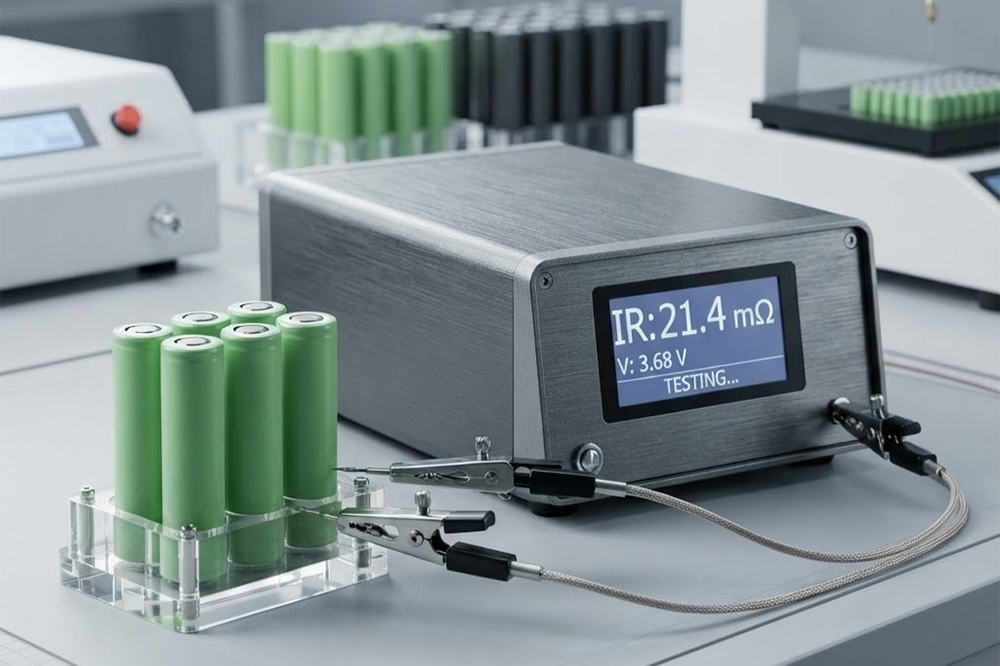
How Do You Test 18650 Internal Resistance?
There are several ways to test internal resistance.
A battery analyzer or dedicated internal resistance tester is the convenient option for production environments.
Some battery chargers and analyzers also provide an estimated resistance value.
The general process is straightforward:
- Check the cell condition.
- Measure the cell voltage.
- Keep the cells at a consistent temperature.
- Use the same testing equipment and method.
- Record the internal resistance.
- Compare cells within the same batch.
For a few cells, manual testing may be enough.
For hundreds or thousands of cells, consistency becomes much more important.
If you are purchasing cells for battery-pack production, a supplier’s incoming inspection process can save a lot of trouble later.

Don’t Compare Resistance Without Considering Capacity
This is another common mistake.
Imagine two cells:
Cell A: 2500mAh, 20mΩ
Cell B: 3500mAh, 40mΩ
Which one is better?
There is no automatic answer.
Cell A may be the better option for a high-current application where voltage stability matters.
Cell B may be more useful when runtime and energy density are more important.
This is why battery selection should start from the application rather than from a single specification.
Capacity, discharge current, internal resistance, dimensions, operating temperature and expected cycle life all need to be considered together.
If you are still comparing 18650 capacity options, our guide to 18650 battery capacity, mAh, Ah and Wh provides a useful starting point before choosing cells based on resistance.
Internal resistance should not be considered separately from capacity. A cell with lower resistance is not automatically the right choice if the application needs longer runtime. If you are comparing 2500mAh, 3000mAh and 3500mAh 18650 cells, our guide to 18650 battery capacity, mAh, Ah and Wh explains how these numbers translate into actual battery energy and pack capacity. This makes it easier to balance runtime against current performance when selecting cells.
High-Drain 18650 Batteries and Internal Resistance
Internal resistance becomes particularly important with high-drain cells.
A high-drain 18650 battery is expected to provide relatively high current without excessive voltage drop or heat generation.
That does not mean every high-drain cell automatically has extremely low resistance.
The complete cell design matters.
If your application draws 15A, 20A or more, I would pay much more attention to resistance than I would for a small sensor that consumes only a few hundred milliamps.
This is also where our previous article on high-drain 18650 batteries fits naturally into the selection process.
The current requirement tells you what kind of cell you need. Internal resistance helps you understand how that cell may behave when the current actually flows.
For high-current equipment, internal resistance becomes much more important because the battery has to deliver a large amount of current without excessive voltage drop or heat. This is where cell selection can become a little tricky. If your project involves power tools, e-bikes, robotics or other demanding equipment, our guide to high-drain 18650 batteries goes deeper into continuous discharge current, peak current, C rating and voltage sag.
Internal Resistance Can Increase as the Cell Ages
A new 18650 cell does not keep exactly the same electrical characteristics forever.
As the cell goes through charge and discharge cycles, chemical and physical changes inside the cell can gradually increase internal resistance.
This can lead to:
- More voltage sag
- Higher heat generation
- Reduced high-current performance
- Lower practical power output
- Reduced usable capacity in demanding applications
This is one reason an old battery can still show a reasonable voltage but perform poorly under load.
For battery packs used in demanding equipment, resistance growth can be an important indicator of aging.
A pack may not suddenly fail.
Instead, performance slowly becomes less reliable.
The equipment may shut down earlier, the motor may feel weaker, or the battery may become hotter than before.

Why Matched Resistance Matters in Battery Packs
Suppose you are building a battery pack with multiple 18650 cells.
Ideally, the cells should be reasonably consistent.
If one cell has noticeably higher internal resistance than the others, it can behave differently under load.
It may experience greater voltage drop and generate more heat.
In series-connected packs, differences between cells can become particularly important because each cell has to work within the same overall pack operating conditions.
For larger battery packs, cell matching should therefore include more than capacity.
A practical matching process may consider:
- Open-circuit voltage
- Capacity
- Internal resistance
- Self-discharge behavior
- Production batch
- Cell age
For professional battery-pack manufacturing, this kind of consistency is usually more valuable than simply finding the lowest-priced cells.
Internal resistance becomes even more important when several 18650 cells are combined into a battery pack. The way cells are connected in series and parallel affects pack voltage, capacity and current capability, while differences between individual cells can also affect pack balance. If you are designing a multi-cell configuration, our 18650 series and parallel configuration guide explains how these arrangements work and what to consider before building a pack.
A Simple Example: 5S Battery Pack
Let’s say a battery pack uses five 18650 cells in series.
Each cell has an internal resistance of 30mΩ.
Ignoring connections, nickel strips, BMS resistance and other factors, the approximate total cell resistance is:
5 × 30mΩ = 150mΩ
At 10A:
10A × 0.15Ω = 1.5V
That means the theoretical voltage drop caused by the cell resistance could reach around 1.5V at that current.
Real battery packs are more complicated because connectors, welding points, BMS components and wiring also contribute resistance.
Still, this simple example shows why internal resistance matters much more as current increases.
Internal Resistance Is Not the Same as Pack Resistance
When testing a finished battery pack, don’t assume the measured resistance represents only the cells.
The complete electrical path includes:
Cells + nickel strip + busbar + BMS + wires + connectors + welds
Every part adds some resistance.
A poor weld can create an unexpected resistance point.
A thin wire can also cause additional voltage drop.
A connector with a poor contact may become hot during high-current operation.
So if a battery pack shows excessive voltage sag, changing the cells is not always the first thing to do.
The complete current path needs to be checked.

What Should Wholesale Buyers Ask a Supplier?
If you are buying 18650 batteries in bulk, I would ask for more than a simple capacity table.
Useful questions include:
- What is the typical internal resistance?
- What testing method is used?
- At what temperature is resistance measured?
- What is the test state of charge?
- Are cells sorted or matched?
- Is resistance tested for every production batch?
- What is the acceptable resistance range?
- Can sample test data be provided?
This becomes especially important when ordering cells for a custom battery pack.
A supplier may quote an attractive price, but if the cells have inconsistent electrical characteristics, the actual cost of production can become higher.
More incoming testing, more sorting and more rejected cells all take time.
How to Use Internal Resistance When Selecting 18650 Cells
I would use a simple selection process.
First, determine the required pack voltage.
Then calculate the expected continuous and peak current.
After that, decide whether the priority is mainly runtime, high power, compact size or a balance of several factors.
Once those requirements are clear, compare candidate cells based on:
Capacity + discharge current + internal resistance + cycle life + temperature range
Not just capacity.
For example, a 3500mAh cell may look better than a 3000mAh cell at first glance.
But if the 3000mAh cell provides better current performance and lower voltage sag, it may be a better fit for a power tool or robotics application.
There is no universal “best 18650.”
There is only a better match for a particular application.
Once the electrical requirements are clear, the next step is finding a cell that actually fits the project. For OEM and wholesale buyers, that usually means comparing capacity, discharge performance, dimensions and consistency rather than choosing a cell based on price alone. You can browse our 18650 lithium battery products to compare available cell options, or contact us if you need help selecting cells for a custom battery pack or larger-volume order.
Final Thoughts
Internal resistance is a small specification with a surprisingly large influence on real battery performance.
It affects voltage sag, heat, current delivery and aging. For low-power electronics, it may not deserve much attention. For high-current equipment and multi-cell battery packs, however, it becomes much more important.
For OEM and wholesale buyers, the main point is simple: do not compare 18650 cells by mAh alone.
If the application requires high current, look at resistance, discharge capability and cell consistency together.
And when comparing suppliers, make sure the resistance numbers are measured under comparable conditions. A number without a test method does not tell you the whole story.
-

12V 4400 mah Lithium ion 3S2P 18650 Battery Pack
-

18650 2000mAh 3.7 volt Lithium-ion Battery
-

18650 20V 3.0Ah Cordless Drill battery
-

18650 22.2V 7.8Ah 2600Mah 6S3P Rechargeable Battery Pack
-

18650 2600mAh Rechargeable Lithium-Ion Battery 3.7V
-

18650 3.7V 10Ah Li-Ion Power Battery Pack
-

18650 3.7V 3300mah Rechargeable Lithium ion Battery
-

18650 7S7P 24V 14Ah Lithium ion Electric Scooter Battery Pack
-

18650 battery 3.7V 1500mAh Lithium-Ion Battery
-

18650 Battery 3500 mah Rechargeable Battery Cells
-

18650 Electric Scooter 48V 13000mAh Lithium Battery
-

2600mAh 3S1P 11.1V 18650 Battery Packs
-

3.7V Li ion Rechargeable 3000mah 18650 Battery Cell
-

36V 5200mAh 10S2P 18650 Battery Pack
-

48v 4400mah 13S2P 18650 Rechargeable Battery Pack
-

7S2P 24V 18650 Lithium Battery Pack
-

Electric Scooter 36V 4400mAH 10S2P 18650 Battery Pack
-

ICR 18650 Battery 2200mah 3.7V
Leave a Reply